Indicator mechanics: RSI, EMA, FVG and Parabolic SAR
Calculate RSI, ZLEMA, candle-gap geometry, Parabolic SAR and EMA warm-up with reproducible examples before assigning trading meaning to their labels.
What you will practise
Audit an indicator’s inputs, state and arithmetic, then distinguish its output from volatility, resting orders, active protection and predictive evidence.
Before you start
- Read candle open, high, low and close values.
- Calculate a percentage, a weighted average and a simple position loss.
Course outline
- 1
RSI is momentum, not volatility: calculate the difference
Rebuild RSI from gains and losses. Two price paths with very different move sizes both produce RSI 66.67, so RSI cannot tell you how much a position can lose.
7 minIn short: RSI = 100 − 100 / (1 + average gain / average loss) measures the balance of recent gains and losses; the price unit cancels in the ratio. Two paths with mean absolute changes of 1.5 and 7.5 both give RSI 66.67, so RSI says nothing about move size or possible loss.
- 2
Test ZLEMA response and overshoot on a known price path
Compare ZLEMA's lag-compensated input with a standard EMA on the same prices. Test response and overshoot before reading zero lag as perfect tracking.
7 minIn short: ZLEMA applies the same exponential update as an EMA to a compensated input, 2 × current close − close two bars earlier. It responds faster to a jump but can overshoot: after closes 110, 110, 110, 100, 100, ZLEMA ends at 99.2181 while the EMA is 103.1276.
- 3
Fair value gaps: separate candle geometry from resting orders
Apply an explicit three-candle FVG rule and inspect the middle bar's trades. A drawn gap is candle geometry, not proof of an institution's resting orders.
7 minIn short: Under the declared rule, a bullish three-candle FVG exists when the third candle's low is strictly above the first candle's high and the middle candle closes above its open. The rectangle is candle geometry; claims about resting orders need trade or order-book records.
- 4
Calculate Parabolic SAR before treating it as an active stop
Calculate the SAR value and its range constraint, then turn it into an order: a computed 99.20 becomes a 98.80 stop, and the assumed exit fills at 97.20.
7 minIn short: In an upward state, raw SAR = previous SAR + acceleration factor × (extreme point − previous SAR), capped at the lower of the two preceding lows, so 99.20 becomes 98.80. A stop at that value still needs a confirmed order, and in the example a gap fills it at 97.20.
- 5
Why two EMAs disagree: reconcile warm-up history and seeds
Calculate how different EMA starting values converge under identical later prices. Matching the latest candles and length is not enough to reproduce an EMA.
7 minIn short: Two EMAs with the same length can differ because of their seed, price source or loaded history. With identical later inputs, the starting difference shrinks as D₀ × (1 − α)^k: at α = 0.2, a difference of 10 needs 21 updates to fall below 0.1.
Calculators used in this course
Related courses
- Chart pattern success rates: audit the full recordAudit pattern success rates, measured targets, re-entry losses, zero-event samples and unresolved outcomes with original calculations and diagrams.
- Backtest bias: validate a trading strategy without hindsightAudit signal timing, ambiguous fills, confirmation filters, parameter searches and chronological holdouts with reproducible worked cases.
- Range trading: breakout acceptance, volume profile and VWAPDefine a range before the breakout, map uncertain cost zones and combine price acceptance with profiles, VWAP and session context.
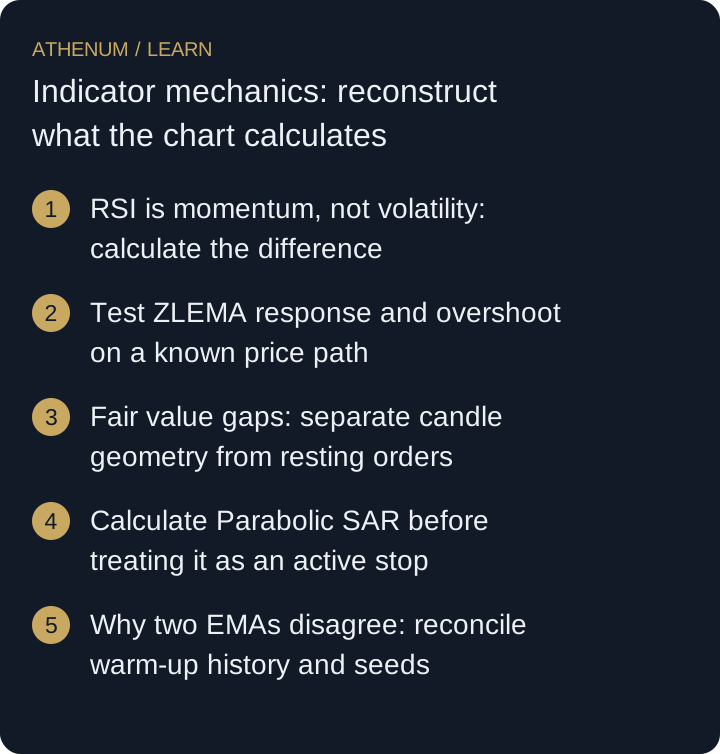 Open full-size diagram
- RSI is momentum, not volatility: calculate the difference
- Test ZLEMA response and overshoot on a known price path
- Fair value gaps: separate candle geometry from resting orders
- Calculate Parabolic SAR before treating it as an active stop
- Why two EMAs disagree: reconcile warm-up history and seeds
Educational material. Examples do not establish a profitable strategy. Trading costs, gaps and liquidation can produce losses beyond a planned stop.