Chart-pattern evidence: from success claims to complete records · 5 / 5
Keep unresolved chart-pattern outcomes in the evaluation
The end of a dataset does not mean every trading idea has a fully observed outcome. A recently formed pattern may have only ten days of follow-up even though the rule allows ninety days. Evaluating only completed cases favors outcomes that become known quickly. The remaining observations must neither disappear nor receive invented results.
Athenum6 minUpdated:
Store the deadline separately from the observation cutoff
The deadline belongs to the predefined rule: for example, target before stop within ninety days of entry. The actual observation cutoff belongs to the dataset. If data ends earlier and neither event has occurred, the outcome is not fully known. This is right censoring. The missing later price path does not become a loss merely because it is absent from the file.
Also specify what happens to cases that reach the regular ninety-day deadline without hitting either level. An event statistic can classify them as no target success within the deadline. A trading strategy additionally needs an executable time-based exit to establish its actual gain or loss. Failure to reach a target does not automatically mean a losing trade.
A completed subset is a selected group
Fast target hits and early stops enter the completed subset sooner than slow-moving positions. Its rate need not equal the eventual rate for all original cases. Show known successes, known non-successes and unresolved observations together. If you are not yet using a suitable method for incomplete follow-up, transparently derived outcome bounds can be more useful than a seemingly precise rate from a selected subset.
Distinguish a planned administrative cutoff from a failed feed. If a data gap hides prices, even the assumed order of target and stop may be unknown. Record why observation ended. Do not extend the original success deadline afterward only for cases still waiting to reach their targets.
Six successes, one stop and three unknown outcomes
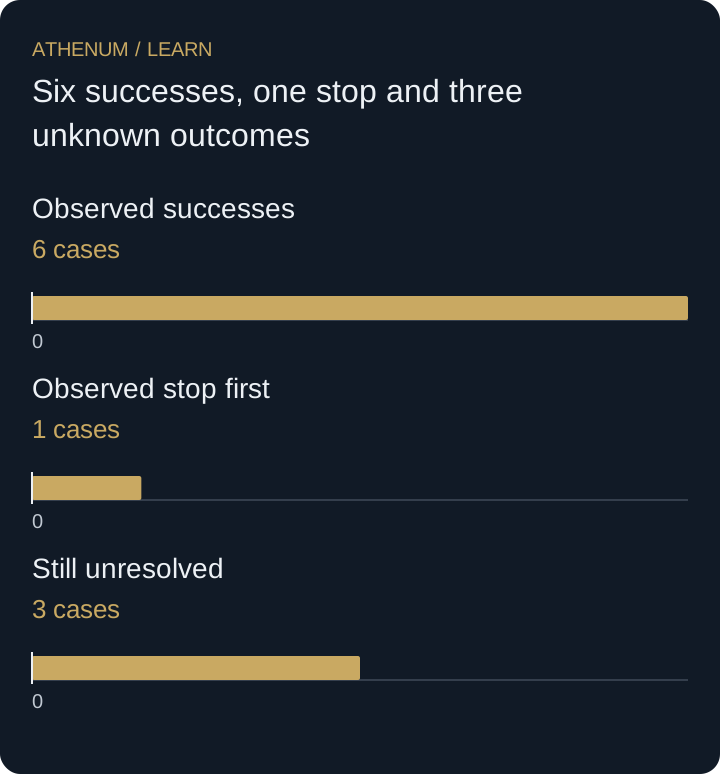
Ten invented entries follow the same predefined rule: the target must occur before the stop and within ninety days. Six entries have an observed target success and one has an earlier stop. At the dataset cutoff, the other three have only thirty, twenty and ten days of follow-up, respectively; neither target nor stop has occurred.
Among the seven resolved cases, the success rate is 6 / 7 ≈ 85.71%. That describes this subset, not the final ninety-day outcome of the original ten entries. If none of the three unresolved cases later succeeds within its deadline, the cohort ends at 6 / 10 = 60%. If all three succeed, it ends at 9 / 10 = 90%. These are logical bounds for these ten cases, not a confidence interval for an unknown market probability.
| Observed state | Count | What is known at cutoff |
|---|---|---|
| Target before stop within deadline | 6 | Success already observed |
| Stop before target | 1 | No success under the predefined event rule |
| Still open after 30, 20 and 10 days | 3 | Outcome within deadline still unknown |
 Open full-size diagram
- Observed successes: 6 cases
- Observed stop first: 1 cases
- Still unresolved: 3 cases
Do not use later gap labels as early entry signals
A related selection error occurs when a gap receives a label because it subsequently closes quickly, and that category’s closure rate is then used as an entry forecast. The later outcome is already embedded in the category. First record features known at the decision time. Keep subsequent closure, its timing and any retrospectively assigned category as outcome data.
Before acting
- Predefine entry, the success event and the regular deadline.
- Store the actual end of observation for each case.
- Report completed and still-open outcomes separately.
- Keep unknown outcomes visible when calculating bounds.
- Distinguish administrative cutoffs, feed failures and regular deadlines.
Check your understanding
Later complete data shows that two of the three unresolved cases reach the target first within their deadlines and one stops out first. What is the final success rate for these ten cases?
Show the explained answer
Eight of ten satisfy the event definition, giving 80%. That falls within the previously known 60–90% bounds. The earlier 85.71% described only the seven cases already resolved at that time. A net trading return still cannot be inferred without quantities, execution prices and costs.