Liquidation data: audit what a reported event actually measures · 1 / 5
Normalize liquidation side labels before comparing venues
A liquidation message labelled Buy does not always describe aggressive buying. A provider can label the position being liquidated, or the order used to close it. A long position is reduced by selling; a short position is reduced by buying. Reusing one Buy-to-long rule across differently defined feeds can reverse an important part of the evidence before any chart is drawn.
Athenum7 minUpdated:
Define the side you want to measure
Use liquidated position side as the target when reporting long and short liquidations. Keep the original provider label and its definition beside that normalized value. Bybit's All Liquidation documentation defines S as position side: Buy identifies a liquidated long. Binance's force-order schema places S inside the closing-order object. For a forced position reduction, a SELL closing order reduces a long and a BUY closing order reduces a short. This is a mapping between meanings, not a rule about the spelling of a label.
A generic Buy label with no provider, channel or schema version is insufficient. Keep it unclassified until its meaning is established. Do not infer position side from whether the marker is above or below the current market, from candle colour, or from a desired explanation of the price move. A valid normalization also preserves the instrument and quantity unit; a contract count cannot be added directly to a coin quantity.
Separate the liquidated position from the counterparty
Knowing that a long was forcibly reduced does not identify who bought the closing quantity. The counterparty might open a new long or close an existing short. The liquidation-side label therefore does not determine the exact change in open interest. It also does not identify a trader's account, entry price or remaining positions. These are separate questions that require their own evidence.
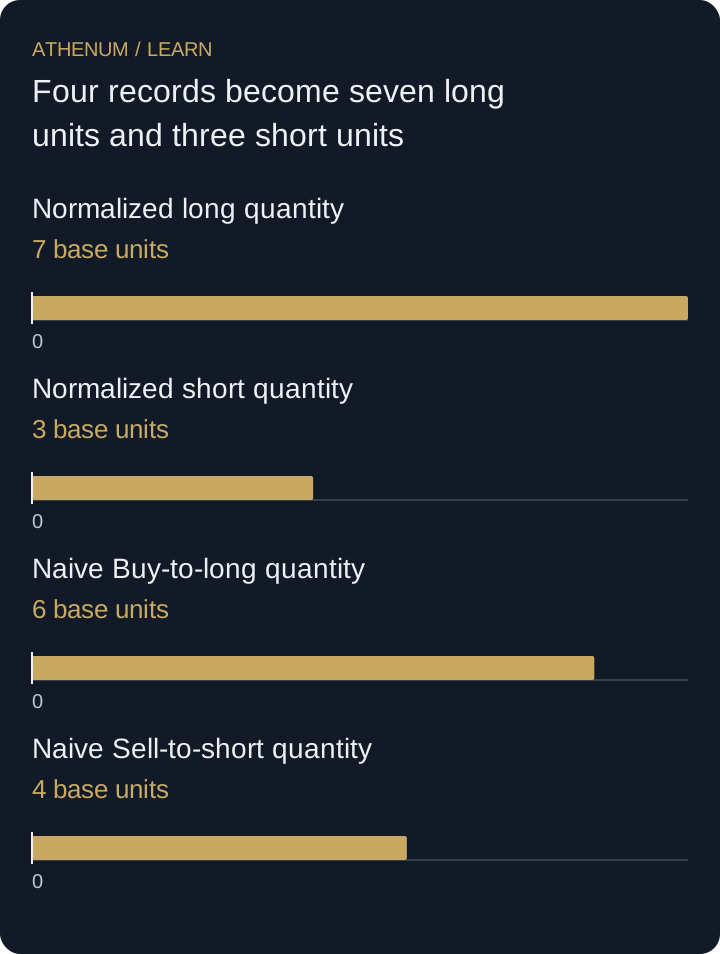
Four records become seven long units and three short units
Use four fictional, non-overlapping observations of the same linear instrument. Every size has already been verified as executed base units. The first two rows use a position-side convention; the next two use a closing-order-side convention. They illustrate the documented meanings but are not downloaded market events. No cross-venue account linkage is assumed.
After normalization, liquidated-long quantity is 4 + 3 = 7 units and liquidated-short quantity is 1 + 2 = 3 units. Treating every raw Buy as long would instead produce 6 long units and 4 short units. Both versions sum to ten, so a correct grand total would not reveal the directional error. The net closing-order direction in this small sample is three buy units minus seven sell units, or −4 units; that is not a complete-market CVD reading.
| Record | Meaning of side field | Raw label | Units | Liquidated position |
|---|---|---|---|---|
| A | Position side | Buy | 4 | Long |
| B | Position side | Sell | 1 | Short |
| C | Closing-order side | SELL | 3 | Long |
| D | Closing-order side | BUY | 2 | Short |
 Open full-size diagram
- Normalized long quantity: 7 base units
- Normalized short quantity: 3 base units
- Naive Buy-to-long quantity: 6 base units
- Naive Sell-to-short quantity: 4 base units
A consistent colour palette cannot repair inconsistent meanings
A dashboard may display green for buys, green for shorts being liquidated, or green for a price rise. A colour cannot replace the side definition. When reading an Athenum liquidation view, identify whether the selected layer represents estimated levels or reported events, and read its side and coverage labels. This lesson's synthetic chart is a calculation aid, not a claim that a particular live marker has been individually verified.
Before acting
- Record venue, channel, instrument and the applicable field definition.
- Choose liquidated position side or closing-order side explicitly.
- Normalize quantities before comparing venues.
- Keep unknown side meanings unclassified.
- Check directional totals as well as the grand total.
Check your understanding
Add one position-side Sell observation of two units and one closing-order SELL observation of one unit to the example. What are the new long and short liquidation quantities?
Show the explained answer
The position-side Sell adds two short units; the closing-order SELL adds one long unit. Long quantity becomes 8 and short quantity becomes 5, for 13 units total. Neither the number of liquidated accounts nor the open-interest change follows from those sums.