Chart-pattern evidence: from success claims to complete records · 2 / 5
Calculate a flag target from explicit reference points
“Half the previous move” is not a complete formula. It might mean half a price difference or half a percentage change. Projecting those quantities from a new starting price produces different targets. A checkable plan therefore needs reference points, units and a formula; a horizontal line alone is insufficient.
Athenum6 minUpdated:
Price differences and returns have different units
A rise from 80 to 120 is an absolute increase of 40 price units and a relative increase of 50% of the starting price. Half the absolute increase is 20 price units. Half the percentage increase is 25%. These are not interchangeable when you project from another price. Addition needs a quantity expressed in price units; a percentage projection multiplies its new reference price by a factor.
Clearly specified rules can be tested even when they produce different results. Choose the rule before knowing the outcome. Switching afterward to the formula whose target fits the chart changes the strategy being evaluated. A logarithmic chart display or a different zoom level must not silently replace a previously declared numerical rule either.
A projected level is not yet an executable profit
A geometric reference point can precede the time at which an entry was possible. Calculate potential reward relative to planned loss from the executable entry and its stop, not the most favorable historical low. Then account for fees and adverse execution. If the exit cannot be executed at the assumed size or price, the trading ledger changes again.
Neither projection formula supplies an event probability. A target is a proposed exit level or a price event to study, not a guaranteed minimum movement. Evaluating it requires a predeclared sample and a complete policy for stops, expiry and execution.
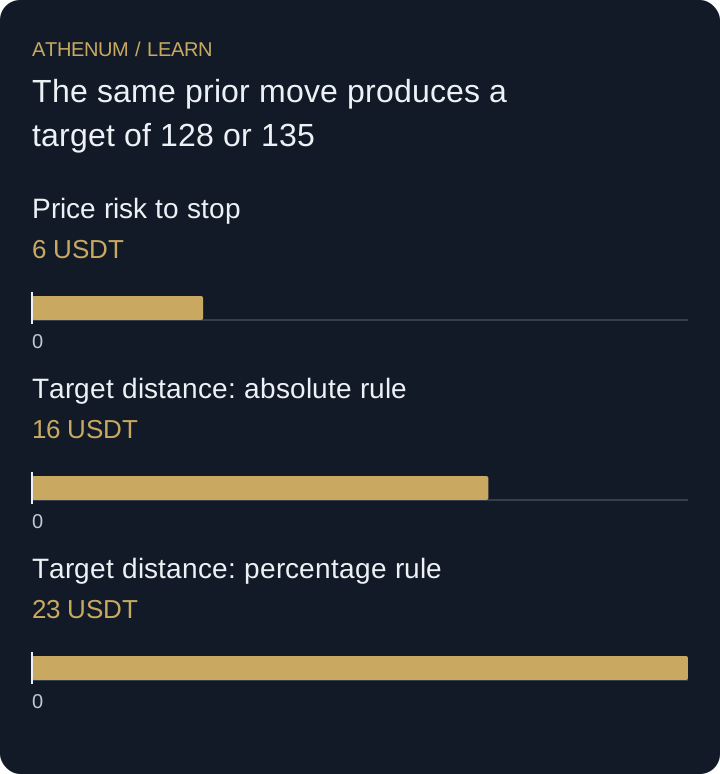
The same prior move produces a target of 128 or 135
Consider an invented prior move from 80 to 120 USDT and a subsequent consolidation low of 108. Rule A adds half the absolute prior rise to that low: 108 + (120 − 80) / 2 = 128 USDT. Rule B applies half the original percentage rise to 108: 108 × [1 + (120 / 80 − 1) / 2] = 135 USDT. The seven-USDT difference comes from different rules, not a rounding error.
Now assume an executable entry at 112 and a stop at 106 in a linear instrument. Planned price risk is six USDT per unit. Before costs, target A offers a 16-USDT distance, or 16 / 6 ≈ 2.67R. Target B offers 23 USDT, or 23 / 6 ≈ 3.83R. A larger or smaller target distance does not tell you how often that exit will be reached before the stop.
| Rule | Projection from 108 | Target | Distance from entry 112 |
|---|---|---|---|
| Half the absolute increase | 108 + 20 | 128 | 16 |
| Half the percentage increase | 108 × 1.25 | 135 | 23 |
 Open full-size diagram
- Price risk to stop: 6 USDT
- Target distance: absolute rule: 16 USDT
- Target distance: percentage rule: 23 USDT
Do not move the reference point after seeing the result
If the consolidation low is confirmed only later, it is not automatically a signal value available at the earlier time. Record the availability time alongside the price location. Revising the low or the extent of the prior move afterward produces a different target. Preserve the original values and evaluate a revision as a new decision available only at that later time.
Before acting
- Record the start, end and information availability of the prior move.
- Calculate its absolute price difference and percentage change separately.
- Declare the projection rule and new reference point in advance.
- Measure reward and risk from the executable entry.
- Evaluate target distance, event probability and net result separately.
Check your understanding
The prior move remains 80 to 120, but the new projection point is 100 instead of 108. What targets do the same two rules produce?
Show the explained answer
The absolute rule gives 100 + 20 = 120. The percentage rule gives 100 × 1.25 = 125. Only the projection point changed; the rules and prior move stayed the same. A new reward/risk calculation also needs the executable entry and corresponding stop.