Chart-pattern evidence: from success claims to complete records · 1 / 5
Audit the denominator behind a chart-pattern success rate
A bull flag can reach its drawn target after a trade has already stopped out. A statistic about eventual target touches therefore answers a different question from a statistic about winning trades. Before comparing percentages, establish which cases enter the denominator, what counts as success and when a position would actually have opened and closed.
Athenum7 minUpdated:
From a visible candidate to an executed trade
Create a candidate record when the predeclared identification features first qualify. Preserve the timestamp, instrument, data source and boundaries known then. A candidate is not yet an entry. An additional rule might require a confirmed continuation breakout. Candidates that never satisfy it remain visible in the ledger; they do not become fictitious losing trades.
Opened positions need a second record: executable entry, stop, target, maximum follow-up and costs. Event order matters. A target reached after the stop describes the subsequent price path but cannot generate profit in a position already closed. When the data cannot establish event order, label the outcome unresolved and examine the supported range instead of assigning the favorable sequence.
Different percentages can all be arithmetically correct
The fraction of all candidates producing both an entry and an eventual target touch, the eventual-touch rate among entries, and the target-before-stop rate measure different events. None should be called a win probability without its definition. A conditional denominator is not inherently misleading: entries can be the appropriate population for a strategy that trades only confirmed breakouts. The problem is hiding the selection rule or changing it after seeing outcomes.
Do not count multiple screenshots or timeframes of the same trade as independent observations. A candidate identifier linked to its trade identifier helps expose duplicates. A large row count alone does not establish a large sample of independent market events.
One hundred candidates, sixty entries and twenty-four wins
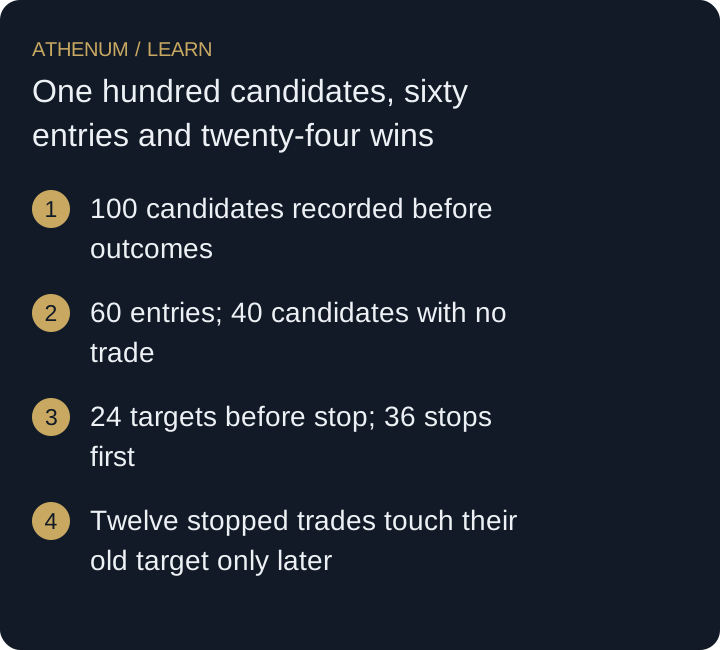
In this invented example, 100 candidates are recorded before their outcomes. Sixty satisfy the entry rule; forty never open a trade. Among the sixty entries, twenty-four reach a +2R target before a −1R stop. The other thirty-six stop first. Twelve of those stopped trades nevertheless touch the old target later. All event sequences are known in this hypothetical ledger.
For the 36/100 measure, the counted event explicitly requires both a qualified entry and a later touch of that entry's target. A nonentry does not qualify for that joint event. This says nothing about the nonentry's other subsequent price movements. R denotes a fixed monetary amount of planned price risk before costs, and every completed trade incurs a hypothetical total cost of 0.1R. Net result is 24 × 2R − 36 × 1R − 60 × 0.1R = 6R: 0.1R per actual entry, or 0.06R per original candidate. Nonentries contribute no trade profit or loss. These numbers do not validate a real trading strategy.
| Measure | Calculation | Interpretation |
|---|---|---|
| Eventual target touches among entries | 36 / 60 = 60% | Includes twelve trades already stopped out |
| Target before stop among entries | 24 / 60 = 40% | Wins under the declared exit policy |
| Candidates with entry and eventual target touch | 36 / 100 = 36% | Joint event: entry followed by target touch |
| Net result across actual trades | 48R − 36R − 6R = 6R | Includes the assumed costs of every trade |
 Open full-size diagram
- 100 candidates recorded before outcomes
- 60 entries; 40 candidates with no trade
- 24 targets before stop; 36 stops first
- Twelve stopped trades touch their old target only later
A high target-touch rate cannot replace the trading ledger
Quoting only the 60% eventual-touch rate can suggest the corresponding trades won just as often. Their win rate under the specified policy is 40%. The toy net result is still positive because of its assumed win and loss sizes. Conversely, a higher win rate can lose money with larger losses and costs. Audit the event definition, denominator and net ledger together before transferring historical pattern statistics to another instrument.
Before acting
- Record candidates using a predeclared rule and timestamp.
- Do not assign fictitious trade outcomes to nonentries.
- Distinguish target touches before and after the stop.
- State the event and denominator for every percentage.
- Keep every actual attempt and its costs in the trading ledger.
Check your understanding
Eight additional stopped trades later touch their old target. What changes in the eventual-touch rate among entries, the actual win rate and net result?
Show the explained answer
The eventual-touch rate rises to 44/60, approximately 73.33%. The completed trades' win rate remains 24/60 = 40%, and their net result stays 6R. A later price movement does not rewrite an earlier execution.