Table of Contents9 sections
- What is the funding number you see between settlements?
- Do these four venues share one settlement clock?
- Does an early read beat simply assuming nothing changed?
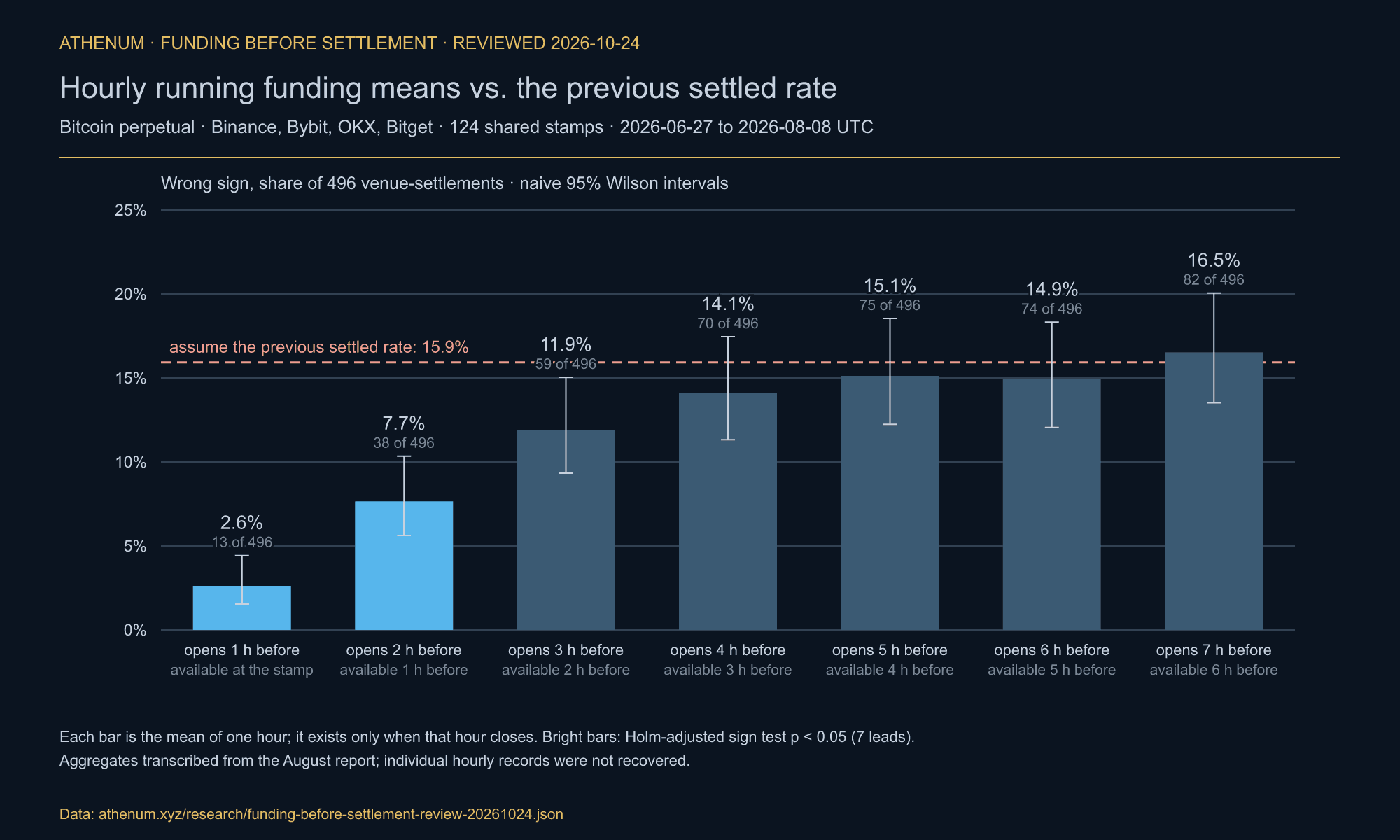
- How often does an early read carry the wrong sign?
- Where do the sign errors concentrate?
- Does the venue you use change the answer?
- How far off is the level, not just the sign?
- What did today's settlement actually look like?
- How do you check this yourself?
The decision before the data
Across 496 Bitcoin venue-settlements to 2026-08-08, hourly running funding means beat the last settled rate robustly only when completed one hour or less before the stamp.
| Your question | What to compare | What this cannot establish |
|---|---|---|
| Act on a running rate early? | Use completed hourly means and record when each one became available. | The hour ending at the stamp is not usable before settlement; the three-hour separation is nominal only. |
| Trust the sign near zero? | Treat small running readings with caution and benchmark them against the last settled rate. | The near-zero split was grouped by the final rate, so it is not a tested threshold for a live reading. |
| Rank venues by screen quality? | Compare like market conditions and account for shared settlement stamps. | Six pairwise Fisher tests: the naive 0.013 becomes about 0.077 after a Holm adjustment, and settlements within a venue are serially dependent. |
Practise with worked lessons
- Test a funding-settlement trade after all costs
Opening just before funding and closing just after looks easy. A 30 USDT receipt cannot cover 100 USDT of fees and slippage even before price moves.
Reviewed 24 October 2026. The individual hourly observations behind this August study were not recovered; the counts are the published aggregates, rechecked for internal arithmetic. Each lead is an hourly mean that exists only once its hour has closed, and grouping by settled size uses information available only after settlement. Data JSON Reproducible audit OKX funding rate API Bybit funding Binance funding rules
TLDR. Between settlements, Binance, Bybit, OKX and Bitget show a running funding estimate that keeps moving until the stamp. This report used Athenum hourly means of that estimate for 496 venue-settlements, four venues at the same 124 stamps, from 2026-06-27 00:00 UTC to 2026-08-08 08:00 UTC. An hourly mean is known only once its hour closes, so the mean for the hour that opens four hours before the stamp becomes available three hours before it. That mean had the opposite sign to the settled rate in 70 of 496 cases (14.1%). Simply assuming the previous settled rate was wrong in 79 of 496 (15.9%), and that mean did not beat that rule (sign test p = 0.33). The hour that opens three hours out, available two hours before the stamp, separates only nominally: 43 against 23, p = 0.019, or 0.093 after a Holm correction across seven leads. Robust separation remains for the two latest hours: 55 against 14 for the hour ending one hour before the stamp, and 71 against 5 for the hour ending at the stamp, which is not available until settlement. Errors cluster where the settled rate ended up near zero, but that grouping uses the final rate and is not a rule a reader can apply in advance.
What is the funding number you see between settlements?
It is a running average aimed at the next stamp, not the rate you were last charged, and two requests twenty seven minutes apart are enough to watch it move. Read anonymously on 2026-08-08 at 08:37 UTC and again at 09:04 UTC, both inside the interval that settles at 16:00 UTC, every one of the four had moved: Binance from +0.006616% to +0.006820%, OKX from +0.004511% to +0.004951%, Bybit from +0.010000% down to +0.008352%, and Bitget from +0.000100% clean through zero to -0.000200%. Now set those eight readings against what the same venues had actually charged at the 08:00 stamp that morning, which was +0.00542% on Binance, +0.00356% on OKX, +0.00389% on Bybit and -0.00010% on Bitget. Not one of the eight equalled its venue's settled rate, and on Bitget the number a reader would have quoted flipped sign inside half an hour.
Two of the four say so in their own documentation, which is worth quoting because it means this post describes documented behaviour rather than alleging anything. OKX's REST API reference calls the field a predicted rate for the upcoming settlement period, says in as many words that it is a forecast and that the final settled rate may differ, and exposes the value that actually settled as a separate field on the same endpoint, settFundingRate, alongside a settState flag; the history endpoint carries the same settled value under a third name, realizedRate. Its WebSocket channel labels the same field a current rate, so the venue is not consistent with itself, but the REST reference is the one that documents the distinction. Bybit's help centre says the funding rate traders see fluctuates in real time until the funding timestamp, that it is not fixed, and that it is updated every minute. Binance's field is named lastFundingRate, which reads like the opposite, and the reading above is what settles the ambiguity: it did not equal the 08:00 UTC settlement.
Scope this to the venues measured, because the convention is not universal. BitMEX documents the opposite arrangement, taking the premium index value at the end of the PREVIOUS eight hour window, which means the upcoming payment is settled before the period it applies to even begins. BitMEX still averages, so what is reversed is the lag rather than the averaging. The theoretical literature on perpetuals generally assumes that design too, treating the funding payment as known at the start of the period. That is precisely why the question is worth measuring on the venues people actually trade rather than assuming.
The mechanism itself is not new and we have published it before. The premium component is sampled repeatedly and averaged across the interval, so the number reflects a window of samples rather than the current instant, as the Athenum explainer on how the premium index keeps a perpetual tethered to spot sets out, and the Athenum walkthrough of the funding formula itself takes the arithmetic apart. What follows is not that mechanism restated. It is a measurement of what it costs a reader who acts early.
Do these four venues share one settlement clock?
For the Bitcoin perpetual, on the day measured, yes, and each venue says so on its own public endpoint. Every field below was read anonymously on 2026-08-08, and they agree on an eight hour interval with stamps at 00:00, 08:00 and 16:00 UTC. That matters because a lead time is only comparable across venues that settle on the same clock, and it is the first thing to confirm before putting any two funding numbers side by side.
Venue | Endpoint field | Interval it reports |
|---|---|---|
Binance | fundingInfo returns fundingIntervalHours | 8 hours |
Bybit | instruments-info returns fundingInterval | 480 minutes, which is 8 hours |
OKX | funding-rate returns fundingTime and nextFundingTime | 28,800,000 ms apart, which is 8 hours |
Bitget | funding-time returns ratePeriod | 8 hours |
Hyperliquid | predictedFundings carries a fundingIntervalHours field | 1 hour |
Three qualifications on that table. It is the Bitcoin perpetual on each venue and not every contract they list, several of which run four hour and one hour intervals. The word the venues use is default, so eight hours is the normal case rather than a guarantee: OKX and Bybit both document an automatic switch to more frequent settlement when the rate reaches its cap or floor, OKX stepping down one level at a time through four hours and two hours to one, Bybit switching straight to hourly. And Hyperliquid is the useful control in that table because its payload also carries other venues' intervals, returning one hour for itself and eight hours for both Binance and Bybit in a single response, so the clock is attested by a third party rather than only by each venue about itself. One caveat on that row: the interval field is present in the live response but does not appear in Hyperliquid's published documentation, so treat it as a runtime observation rather than a documented contract, and read every interval off the API rather than assuming it is fixed.
Hyperliquid is then excluded from the study, for a mechanical reason: every lead tested here, from one hour to seven, equals or exceeds its entire funding interval, so "four hours before settlement" is not a question that can be asked on a one hour clock. Deribit is excluded for the reason an earlier Athenum post on perpetual costs already gave, that its funding updates continuously rather than on a fixed clock. We have also already covered the separate point that raw quoted numbers are not comparable across different clocks, and the Athenum guide to funding rate intervals makes that case. This post sharpens that guide rather than restating it: the rate does not only change at the stamp, it drifts the whole way there, which means a mid-interval read of the kind that guide tabulates is not yet the rate anyone will be charged.
Does an early read beat simply assuming nothing changed?
Only for the latest hourly means, and the timing matters. A bare wrong-sign percentage is a weak result on its own, because the honest comparison is not against a coin flip but against the laziest rule available: ignore the screen and assume the rate will settle where it last settled. Over these 496 settlements that rule was wrong 79 times, or 15.9%. Every hourly mean that opens four hours before the stamp or earlier sits statistically on top of it. Note the label: each lead names the hour in which the mean was computed, so the mean is first available one hour after that label.
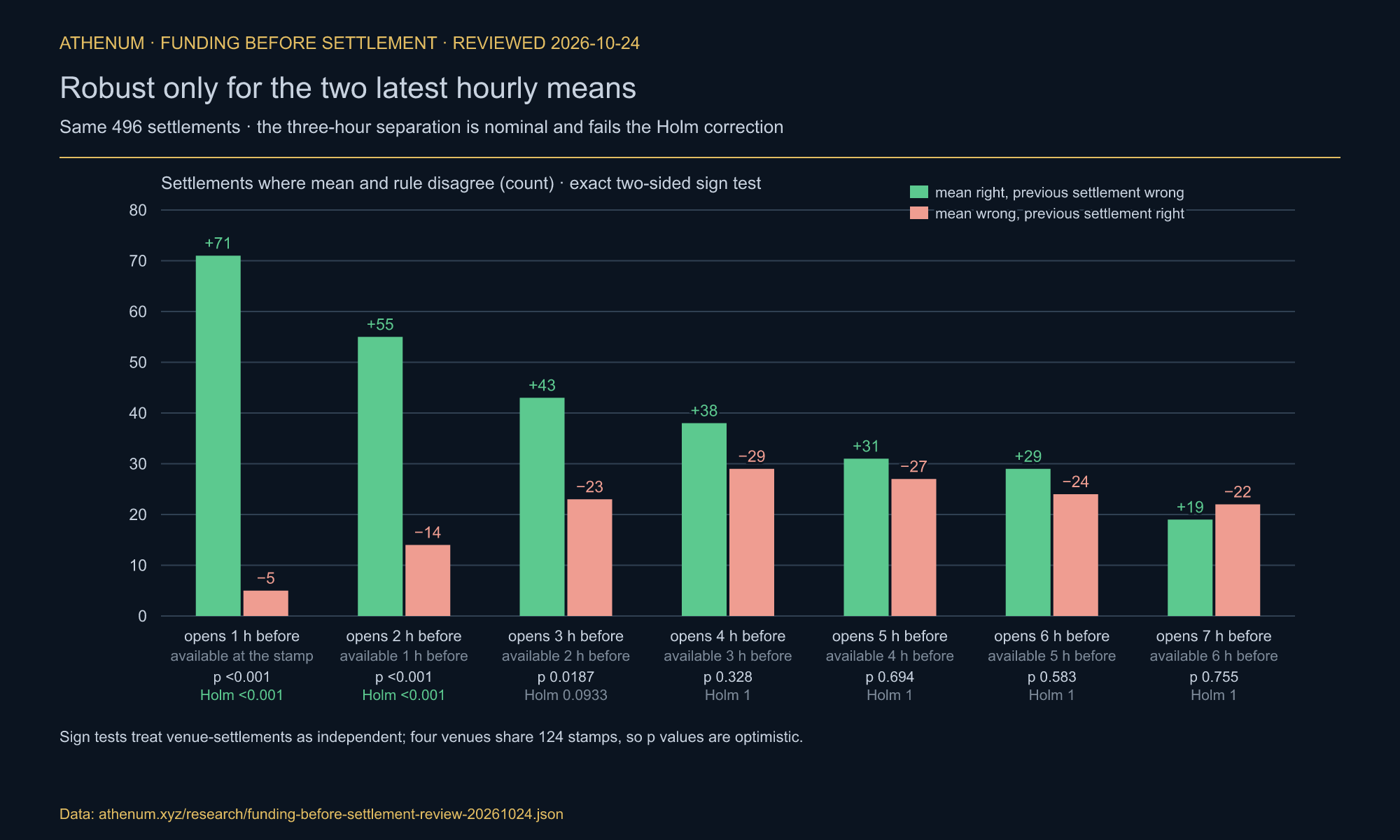
Only the settlements where the hourly mean and the previous-settlement rule disagree, so agreements cannot pad either side. Each lead is the hour that opens that many hours before the stamp. After a Holm correction for seven leads, only the hours opening one and two hours before the stamp separate; the hour opening three hours out is nominal (p = 0.019, adjusted 0.093). By seven hours the rule is nominally ahead, 22 against 19.
Tested pairwise on the same settlements, for the hour ending at the stamp the mean was right and the rule wrong 71 times, against 5 the other way, an exact two-sided sign test at p below 0.001. That mean exists only at settlement, so it describes convergence rather than an advance signal. For the hour ending one hour before the stamp it is 55 against 14, again below 0.001 and still clear after the Holm adjustment; this is the earliest robust reading in the sample. For the hour ending two hours before it is 43 against 23, p = 0.019 nominally and 0.093 after adjustment. For the hour ending three hours before it is 38 against 29, p = 0.33. These sign tests treat 496 venue-settlements as independent, which four venues sharing 124 stamps do not fully satisfy.
Later means converge, and in one direction. Between the mean for the hour opening four hours out and the mean of the final hour, which is complete only at settlement, 57 settlements were wrong earlier and right later. Going the other way, right at four hours and wrong in the final hour, there were none at all. A paired test on that comparison returns p below 0.001. In this window, later means never lost a sign the earlier one had right.
How often does an early read carry the wrong sign?
In 70 of 496 settlements for the hourly mean that opens four hours before the stamp, and in 13 of 496 for the mean of the final hour, which is complete only at the stamp. The panel is four venues watched at the same 124 settlement stamps, restricted to stamps that carry a usable hourly mean at every lead from one to seven hours and a previous settlement to compare against, so every row below has the same denominator of 496.
Hourly mean: opens → available | Premium weight sampled at hour open* | Wrong sign | Share | Naive 95% interval | Sign test against the previous settlement |
|---|---|---|---|---|---|
opens 1 h before → at the stamp | 77% | 13 of 496 | 2.6% | 1.5% to 4.4% | 71:5, p < 0.001; Holm p < 0.001 |
opens 2 h before → 1 h before | 56% | 38 of 496 | 7.7% | 5.6% to 10.3% | 55:14, p < 0.001; Holm p < 0.001 |
opens 3 h before → 2 h before | 39% | 59 of 496 | 11.9% | 9.3% to 15.0% | 43:23, p = 0.019; Holm p = 0.093 |
opens 4 h before → 3 h before | 25% | 70 of 496 | 14.1% | 11.3% to 17.5% | 38:29, p = 0.33; Holm p = 1 |
opens 5 h before → 4 h before | 14% | 75 of 496 | 15.1% | 12.2% to 18.5% | 31:27, p = 0.69; Holm p = 1 |
opens 6 h before → 5 h before | 6% | 74 of 496 | 14.9% | 12.1% to 18.3% | 29:24, p = 0.58; Holm p = 1 |
opens 7 h before → 6 h before | 2% | 82 of 496 | 16.5% | 13.5% to 20.1% | 19:22, p = 0.76; Holm p = 1 |
*The weight column is an illustration computed from the venues' published premium-index formula, not a measurement. For the eight-hour contracts measured here, all four venues publish a time-weighted average premium index in which the first sample counts once, the second twice and the last n times; Binance uses a plain average on its one-hour symbols. Binance, and Bitget from 2026-07-10, average 5,760 samples taken every five seconds, Bybit and OKX 480 taken every minute. The column shows the share of that premium weight already sampled when the hour opens. For a linear weighting this is very nearly the square of the elapsed fraction: 25.05% on 480 samples and 25.00% on 5,760 at the halfway point. It is not the share of the final funding rate already fixed, because the published rate adds an interest component and applies clamps and caps. Each hourly mean also includes samples up to the end of its hour, when more weight has accrued than the column shows.
Two honest limits on those 496. They are four venues watched at the same 124 stamps, not 496 independent draws. At the four hour lead the flips fell across the stamps as 73 with none, 34 with one venue, 16 with two, none with three, and 1 where all four flipped together, and that last case is essentially impossible under independence, so the intervals above are optimistic rather than conservative. And the hourly series carries two gaps inside the window: six hourly readings missing on 2026-07-01 for three of the four venues and seven for Bitget, whose gap opens an hour earlier, and twenty one missing across a twenty two hour break from 2026-07-31 03:00 UTC to 2026-08-01 01:00 UTC. Those cost four settlement stamps between them. A fifth is lost at the very start of the feed, whose earliest hourly bar is 2026-06-26 14:00 UTC, so the stamp at 16:00 that day has no seven hours of history behind it. That is why 129 stamps fall inside the feed's range and 124 survive into the panel.
Where do the sign errors concentrate?
In hindsight, almost entirely in settlements that ended up near zero. Split the same 496 at the median absolute settled rate, 0.0048% per eight hours, and the halves behave differently. In the larger half the sign was right in all 248 cases for the two latest hourly means; in the smaller half it was wrong 13 times for the final hour and 65 times for the hour opening four hours out. The split uses the settled rate, which is known only after the stamp. It shows where errors occurred; it is not a threshold a trader can apply to a live reading, and this report did not test a split by the size of the running mean itself.
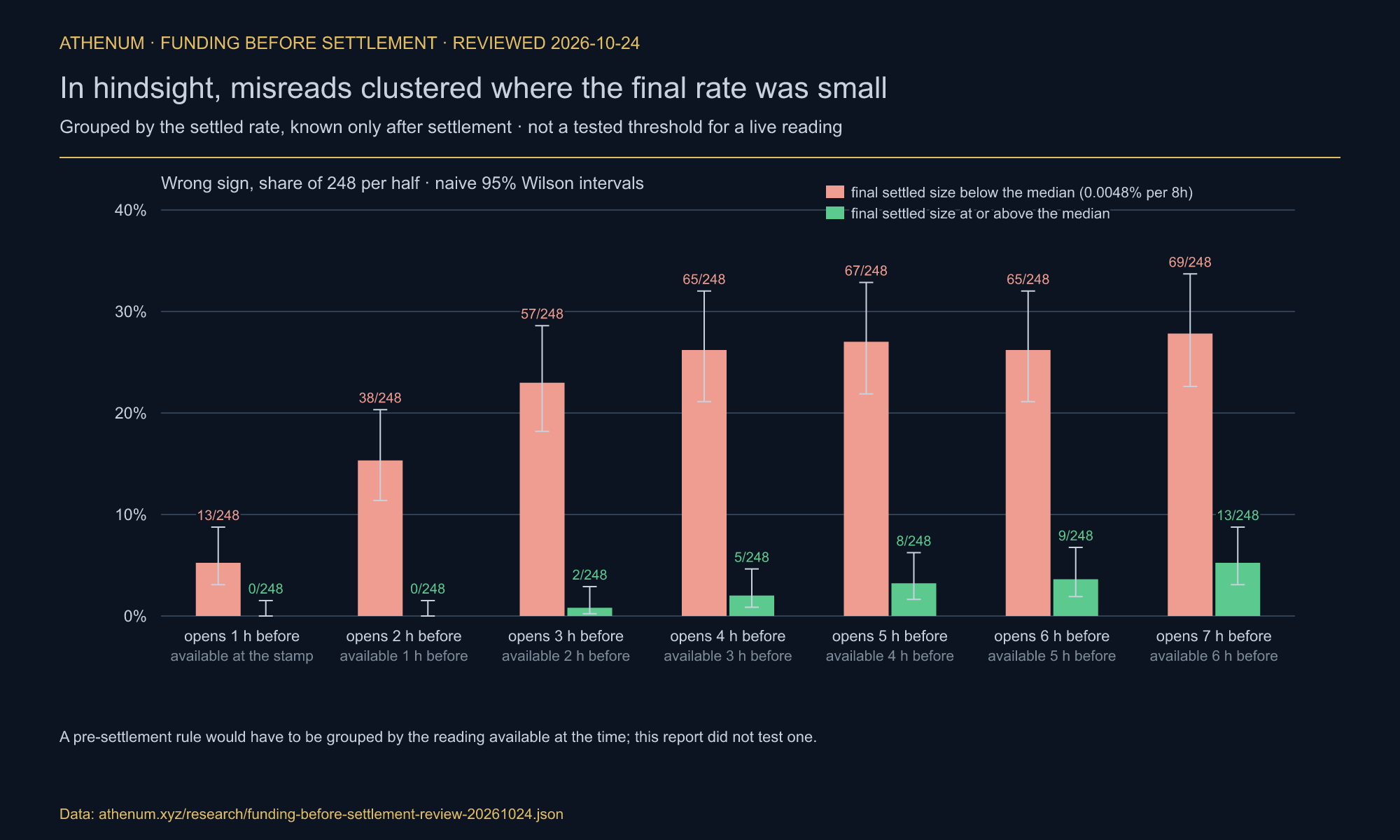
The same 496 settlements split at the median settled magnitude, a value known only after settlement. In the larger half the sign was right in all 248 cases for the hours opening one and two hours before the stamp. By the hour opening seven hours out even the larger half was wrong 13 times, so this is a gradient rather than a guarantee.
For the hour opening four hours out that is 26.2% against 2.0%, and for the final hour 13 of 248 against 0 of 248. Because the groups are defined by the settled rate, these gaps describe where errors fell after the fact, not a tested rule.
The useful takeaway is narrower than a trading rule. Sign errors were concentrated in settlements whose final rate was small, and those are also the settlements where a wrong sign moved the payment least. Because the grouping uses the final rate, it does not show that a running reading far from zero can be acted on hours early; that would need a test grouped by the reading available at the time.
Does the venue you use change the answer?
In the raw counts yes, with two qualifications. For the hourly mean that opens four hours before the stamp, the counts are Binance 9 of 124, OKX 15 of 124, Bybit 23 of 124 and Bitget 23 of 124. A Fisher exact test that treats each settlement as independent puts Binance apart from Bybit and Bitget at p = 0.013. Across six pairwise comparisons a Holm adjustment lifts that to about 0.077, and settlements within a venue are serially dependent, so these p values are indicative rather than confirmatory.
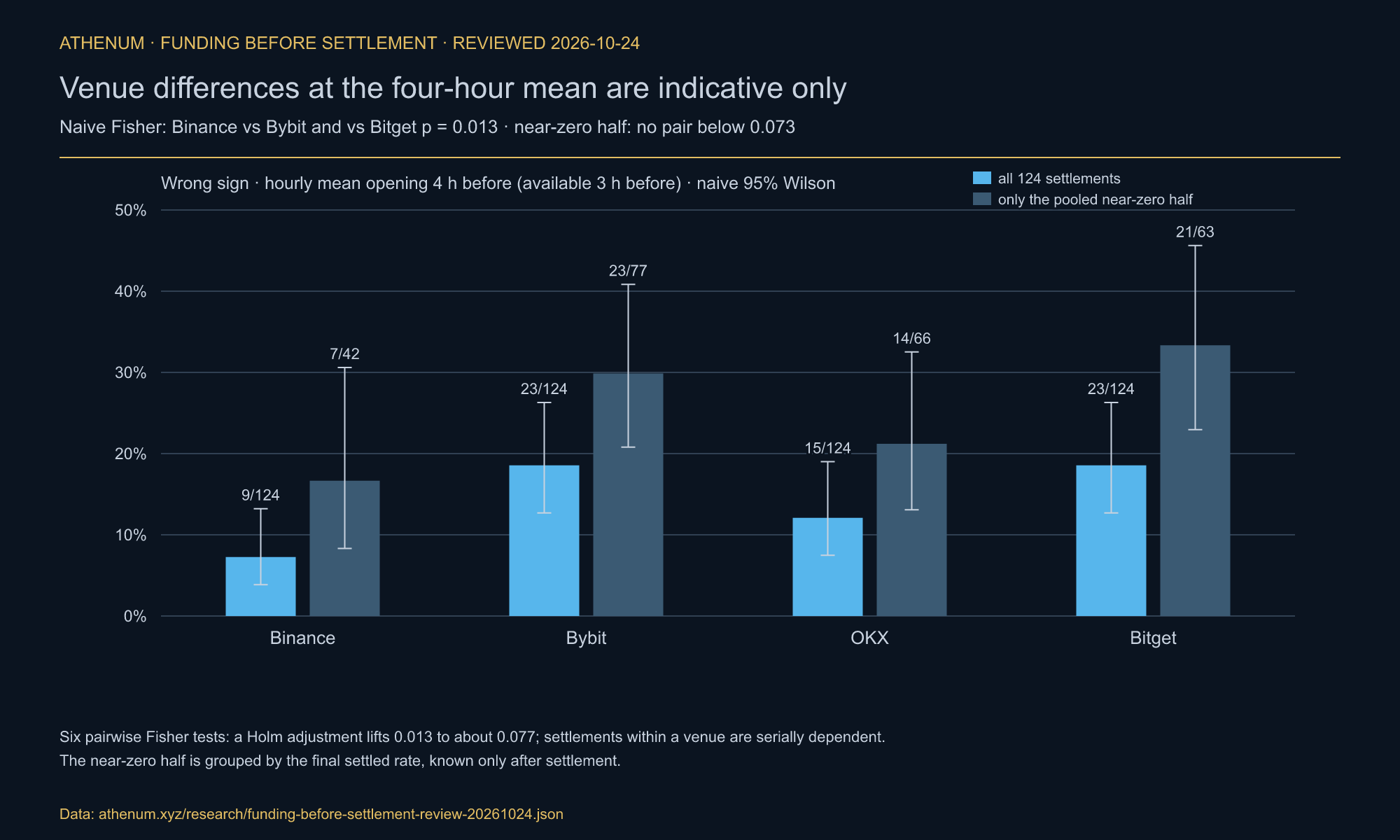
Wrong-sign share for the hourly mean that opens four hours before the stamp, by venue, with naive 95 percent Wilson intervals. The left bar of each pair is all 124 settlements; the right bar is only that venue's settlements whose final rate fell in the pooled near-zero half. Binance differs from Bybit and Bitget on the full set at a naive p = 0.013, about 0.077 after a Holm adjustment for six pairs; within the near-zero half none of the six pairs separates, the smallest p being 0.073.
But the ordering is not a fact about the screens, and the control that shows this is the same near-zero mechanism from the section above. A venue whose funding rarely approaches zero cannot produce many sign errors. Taken from each venue's own settled history with no Athenum data involved, Binance's Bitcoin funding sat below the pooled median in only 42 of 124 settlements, against 77 for Bybit, 66 for OKX and 63 for Bitget, and Binance was positive at 123 of 124 stamps with a median absolute rate of 0.00585%, against 0.00380% for Bybit. Binance had the easier six weeks, repeatedly.
So condition on the hard cases, with the same hindsight caveat. Restrict every venue to its own settlements in the pooled near-zero half: Binance 7 of 42, OKX 14 of 66, Bitget 21 of 63, Bybit 23 of 77. Within that group no pair separates (smallest naive p = 0.073), which is consistent with the raw gap mostly reflecting where each venue's funding sat; it does not show that the screens are equally good.
Two further measurable things push the same way. All 124 of Bitget's settled rates here are exact multiples of 0.000001, six decimal places, while Binance and Bybit publish eight and OKX up to twelve, so near zero a coarser grid can push a rate across the line on rounding alone. And the venues do not sample identically, so this is not one number measured four ways: Binance and Bitget take a sample every five seconds while Bybit and OKX take one a minute. That last split is newer than it looks. Bitget announced on 2026-07-02 that it would move from one minute to five seconds effective 2026-07-10 in UTC+8, subject to the actual deployment, which falls inside this window, so its screen does not behave the same way in the first two weeks of the panel as in the last four. Bitget is also the venue where the three hour result is individually strongest, so treat that particular row with more caution than the pooled figure.
One more caveat belongs in this section rather than in a footnote. The three-hour row is a pooled, nominal result, and no single venue's 124 settlements establish it. For the hour opening three hours out the mean beats the previous-settlement rule 18 to 7 on Bitget (p = 0.043), 13 to 6 on OKX (p = 0.17) and 12 to 7 on Bybit (p = 0.36), and on Binance it loses, 0 to 3. For the hour opening four hours out Binance's previous-settlement rule beat its mean 7 to 0 (p = 0.016). When a venue's funding almost never crosses zero, assuming nothing changes is an excellent rule and a drifting estimate can only add mistakes. Dropping Binance after the fact gives 43 to 20 (nominal p = 0.005), but that is a post-hoc subgroup and does not change the Holm-adjusted verdict: the three-hour row is nominal for the pool and established for no single venue.
How far off is the level, not just the sign?
Further, and it degrades steadily. The median absolute gap between the read and the settled rate runs 0.036 basis points in the final hour, 0.140 at three hours and 0.180 at four, against settled rates whose own median magnitude is 0.48 basis points. In other words a four hour read typically misses by more than a third of the size of a typical settled rate, which is a large miss on a small number.

Absolute error in basis points, median with the 25th to 75th percentile band. Shown in absolute terms deliberately: as a share of the settled rate the same error looks enormous only because that rate is often close to zero.
This is deliberately in absolute terms. Dividing the error by a settled rate that is frequently near zero produces percentages in the hundreds and flatters the point rather than testing it. In basis points the reading is sober: at the four hour lead the middle half of readings misses by between 0.065 and 0.339 basis points, and even in the final hour the middle half misses by between 0.013 and 0.072.
What did today's settlement actually look like?
Like one venue crossing zero by the full width of the number in the last hours, a second grazing it, and only one of the four never coming close. Into 2026-08-08 08:00 UTC, Bybit's hourly mean was -0.00665% for the hour opening seven hours out and still -0.00162% for the hour opening four hours out, both saying shorts would pay, then +0.00009% for the hour opening three hours out, and it settled at +0.00389%, longs paying instead. A reader acting on the mean available three hours before the stamp had the direction backwards.

The 2026-08-08 08:00 UTC settlement. Each line is one venue's running rate averaged over the hour beginning that many hours before the stamp, and the large hollow marker is what the venue actually charged. Read four hours out, only Bybit had the sign wrong, and it was wrong by the full width of the number.
The other three behaved. Binance read +0.00434% seven hours out and charged +0.00542%, right in sign the whole way but a fifth below what it charged. OKX read +0.00210% seven hours out, dipped to -0.00008% five hours out, which is a sign error at that lead by the width of a rounding, and charged +0.00356%. Bitget read -0.00226% seven hours out and charged -0.00010%, correct in sign but essentially zero, which is exactly the near-zero regime where the sign carries the least information.
For scale on the same instant, the last complete hourly bar before that stamp, 07:00 UTC on 2026-08-08, carried Bitcoin at $64,956.24. We are deliberately not putting an aggregate open interest figure next to it: the Athenum post on whether open interest counts one side or both showed that a raw cross-venue sum runs about 20% high because some venues count both legs of every contract, and nothing in this post needs the number. Hyperliquid quoted +0.00045% on its one hour clock at that bar, which is not on the same scale as the others and should not be lined up beside them.
How do you check this yourself?
Every input is public and none of it needs an account.
1. Get the settled series. Binance fapi/v1/fundingRate, Bybit v5/market/funding/history, OKX api/v5/public/funding-rate-history where the settled value is realizedRate, Bitget api/v2/mix/market/history-fund-rate. Each returns the Bitcoin settlements inside your window.
2. Watch one number move. Request any venue's live funding endpoint twice, twenty minutes apart, inside an interval. If the two values differ, that venue's displayed rate is not the rate it last charged.
3. Confirm the clock before comparing anything. Pull the interval fields in the table above. A venue on a one hour clock cannot be set beside one on eight hours without converting both, and the free Athenum funding rate calculator carries an explicit eight hour, four hour and one hour selector for exactly that.
4. Record when each value became available. An hourly mean is known only after its hour closes; a snapshot is known when you take it. Store that time, not only the hour a window opened.
5. Benchmark against the lazy rule, not against zero, and correct for testing several leads. In this window only the hourly means completed one hour before the stamp or later separated after a Holm correction.
6. Do not group by the settled rate when designing a rule. The finding that larger settled rates were rarely misread uses the outcome; a usable threshold must be tested on the reading available at the time.
7. Condition before you rank and account for shared stamps. If one venue looks better than another, check whether its funding simply sat further from zero over your window.
Three limits worth stating rather than burying. The Athenum hourly bar is an average over its hour and not an instantaneous sample, so each lead above is an hour-long window labelled by where it opens and available only where it closes. Seven leads were tested against the same benchmark; holding the family-wise error rate at 5% by the Holm method, the hours opening one and two hours before the stamp survive while the three-hour separation does not (adjusted p = 0.093). The August report also cited a stamp-level bootstrap (about p = 0.017) and a stamp-clustered permutation (p = 0.022) for that row; the underlying records were not recovered in this review, so those values could not be re-run, and the three-hour row should be read as nominal. Six weeks of one asset on four venues is a limited sample, and the printed intervals assume an independence that shared stamps do not provide. The levels belong to this window: the median absolute settled rate of 0.0048% per eight hours is under half of the 0.01% interest component in the venues' formulas, and a more directional stretch could produce a different flip rate. What the data support is the shape: hourly means completed one hour before the stamp or later beat the previous settled rate after correction; the mean completed two hours before separated only nominally; means completed three or more hours before did not.
One last note on where this sits, stated narrowly because the broad version would be unfalsifiable. The predicted-versus-realized distinction is itself well documented: Coin Metrics and Amberdata both sell the two series separately, and OKX labels them fundingRate and realizedRate in its own API. What we could not find is anyone publishing the magnitude of the gap, meaning an exchange research note, vendor study or paper that quantifies how far a venue's running read sits from the rate it then charges. The nearest academic work goes at adjacent questions: one paper forecasts the next settled rate from the history of settled rates and scores itself against a no-change benchmark, and another measures funding-rate spreads across dozens of venues on tens of millions of observations. Neither asks how far the exchange's own displayed number sits from the rate that exchange then charges, which is the only question here. If such a measurement exists we would like to see it. The numbers above are ours, and they are meant to be re-run rather than believed.
Nothing above needed a paid data terminal and none of it needed permission: every settled rate came from a venue's own public history endpoint, and the hourly path between the stamps came from Athenum's live cross-venue derivatives feed, with the calculators beside it free to use, no account, no email and no usage limits. The funding rate calculator linked above turns a per-interval rate into an annual one; if you want to go the other way and compound an annual rate, that is the free Athenum APR and APY calculator. Or take a free 7 day Athenum Pro+ trial and watch the next stamp arrive instead of reading about the last one.
One terminal. All the data.
Liquidations, orderbook depth, whale walls & open interest, all real-time, in one place. 29 supported exchanges; coverage differs by tool.
No credit card required

Athenum Analytics
Athenum Analytics is our three-person editorial team covering crypto derivatives, market data and macroeconomic context.