Funding rates and basis trades: costs, crowding and carry · 5 / 5
Test a funding-settlement trade after all costs
Opening just before a funding settlement and closing just after it can look like a quick way to collect a payment. The receipt is only one line in the trade ledger. Fees, adverse price movement, rate changes and uncertain execution timing can easily dominate it.
Athenum8 minUpdated:
Funding eligibility and look-ahead bias from the settled rate
Read the venue's rules for which positions qualify at the settlement boundary. Do not assume a local clock, a submitted order or an acknowledgement proves the position was eligible. Fills, exchange timestamps and the resulting account funding record are the evidence needed to evaluate the event.
Store the rate estimate available when the decision was made, the final settled rate and any interval change. A historical test using the final rate to choose an earlier entry can look profitable because it knows information that the trader did not yet have. The same applies to using the best price during the settlement window after seeing all the trades.
Funding rate farming: net trade result across every eligible event
For an unhedged position, net result equals price P&L plus funding received minus funding paid minus trading and execution costs. An opposing hedge changes the price risk but adds another set of executions, basis exposure and collateral requirements. Evaluate the complete structure rather than comparing a funding percentage with zero.
Test all eligible events under fixed timing, fill and exclusion rules. Include changed rates, missed entries, unfilled exits, outages and negative outcomes. A parameter selected from the same events it is evaluated on is exploratory evidence, not validation. Use a later untouched period and keep the original decision-time data.
Example: 30 USDT funding on a 100,000 USDT short
Assume a hypothetical 100,000 USDT short is eligible to receive a positive 0.03% settlement: 30 USDT. Entry and exit each cost 0.04% in fees, totalling 80 USDT at an unchanged notional. Add 20 USDT of round-trip adverse execution. Even with zero price movement, net result is 30 − 80 − 20 = −70 USDT.
If the underlying rises 0.2% while the base quantity stays fixed, the short loses 200 USDT before execution costs. The reference exit notional becomes 100,200 USDT, so projected fees are 40 + 40.08 = 80.08 USDT. With the same 30 funding receipt and 20 execution allowance, the budgeted result is 30 − 80.08 − 20 − 200 = −270.08 USDT. The funding valuation is assumed to remain 100,000 USDT at settlement; the adverse move occurs afterward. Receiving funding does not establish an edge, and neither would a favourable price move alone.
This is a pre-trade cost budget: percentage fees use the reference entry/exit notionals, while the 20 USDT execution allowance is a separate stress deduction. An actual ledger must use filled quantities and prices, calculate fees on those actual fills and avoid charging their embedded spread/slippage twice. The budget does not include the small fee change caused by the execution allowance itself.
| Component | Flat-price scenario | Price rises 0.2% |
|---|---|---|
| Funding received | +30 USDT | +30 USDT |
| Round-trip fees | −80 USDT | −80.08 USDT |
| Execution allowance | −20 USDT | −20 USDT |
| Price P&L | 0 USDT | −200 USDT |
| Net result | −70 USDT | −270.08 USDT |
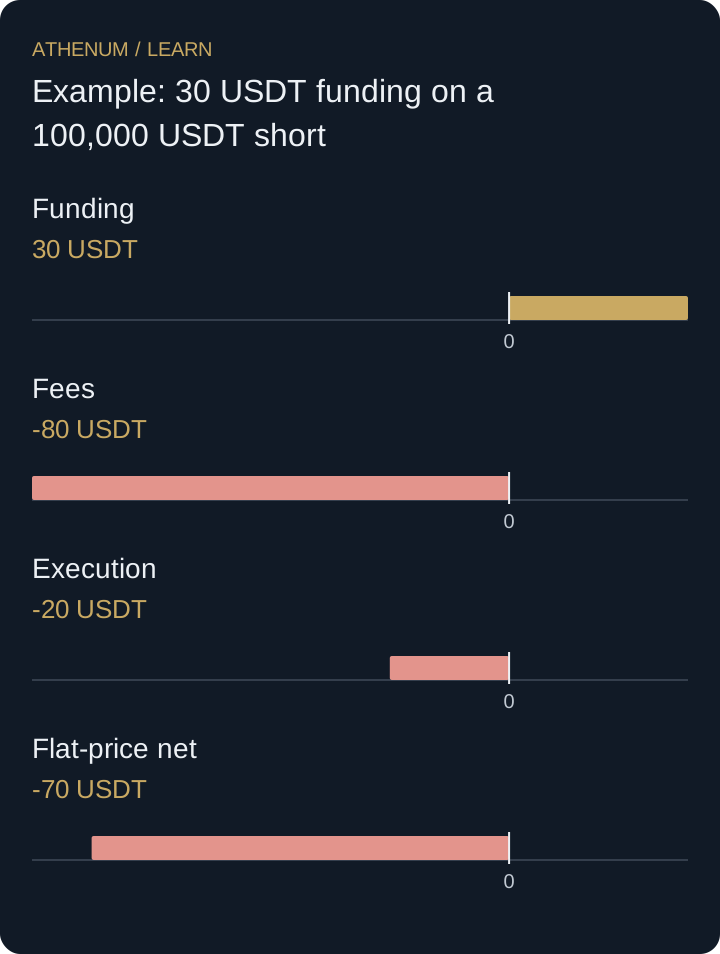 Open full-size diagram
- Funding: 30 USDT
- Fees: -80 USDT
- Execution: -20 USDT
- Flat-price net: -70 USDT
Mistake: entering seconds before settlement and missing eligibility
Trying to minimise exposure by entering extremely close to settlement increases sensitivity to latency, partial fills and the venue's processing window. The order can miss eligibility while still leaving a live position and trading costs. A realistic test must model or observe those failures; assigning every attempt a full receipt and instantaneous exit manufactures an advantage.
Before acting
- Verify settlement eligibility, interval and exchange timestamps.
- Save the rate estimate available at decision time.
- Include both fees, spread/slippage and price P&L.
- Record missed eligibility, partial fills and failed exits.
- Evaluate frozen rules on later events with realistic execution.
Check your understanding
On the same 100,000 USDT notional, the funding receipt doubles to 0.06% while fees and execution remain 100 USDT total. What is the flat-price result?
Show the explained answer
The receipt becomes 60 USDT, so the flat-price result is 60 − 100 = −40 USDT. The receipt must exceed the full cost budget before a flat-price event is positive, and even then adverse price movement or missed eligibility can produce a loss.
Sources and further reading
Continue with Athenum
From the Athenum blog
Bitcoin Funding Rates Only Beat the Last Settlement in the Final Three Hours
Related lessons
- Funding turns negative: compare holding a hedge with closing it
A negative funding rate does not decide the exit alone. Compare holding and closing a spot–perp hedge from the decision time, ignoring funding already earned.
- Trading benchmark: compare net results on the same capital and dates
Gross outperformance can reverse after costs. Compare a strategy with a declared benchmark on the same capital, dates and cash flows, then explain exposure.