Funding research: reconcile payments, rates and hedge decisions · 5 / 5
Funding turns negative: compare holding a hedge with closing it
A long-spot, short-perpetual hedge that previously received funding may face a payment after the rate turns negative. Earlier receipts do not decide whether to keep the hedge. Compare the additional cash flows and price changes of feasible alternatives from the same decision time. A negative next payment can make waiting less attractive, but the difference also depends on basis movement, borrowing and the cost of closing both legs.
Athenum10 minUpdated:
Restart the comparison at the decision time
Treat funding and fees already settled before the decision as common history. They belong in the full trade record, but adding them to one future branch and not the other biases the comparison. Define both alternatives at the same starting valuation and compare wealth at a common horizon. State what happens to proceeds after an immediate exit; cash interest or alternative exposure can matter if the horizon is long.
For a matched one-unit long spot and short linear perpetual in the same quote currency, define basis b = perpetual price − spot price. From the decision time to a later exit, combined price P&L equals current basis minus exit basis. Add future signed funding, subtract additional borrowing and subtract exit costs. Compare that result with the immediate branch's costs and any remaining obligations. Use quantity-adjusted cash flows for larger positions, and a different payoff calculation for inverse or mismatched hedges.
Compare executable branches and conditional scenarios
The close-now branch avoids a future settlement only if the relevant position actually ceases to qualify before that event. Bybit warns that trades very close to its settlement boundary do not guarantee inclusion or exclusion. If an exit is blocked or one leg remains open, replace the idealized immediate branch with the earliest feasible execution and its residual exposure. Both alternatives need a way to repay any remaining loan.
The wait branch contains unknowns: the final rate, settlement notional, future basis, borrowing charges and exit execution. Calculate scenarios and the break-even condition before attaching probabilities. A scenario that beats immediate exit does not establish that its assumed basis move will occur. Margin and liquidity constraints can also make a numerically attractive branch infeasible before the planned exit.
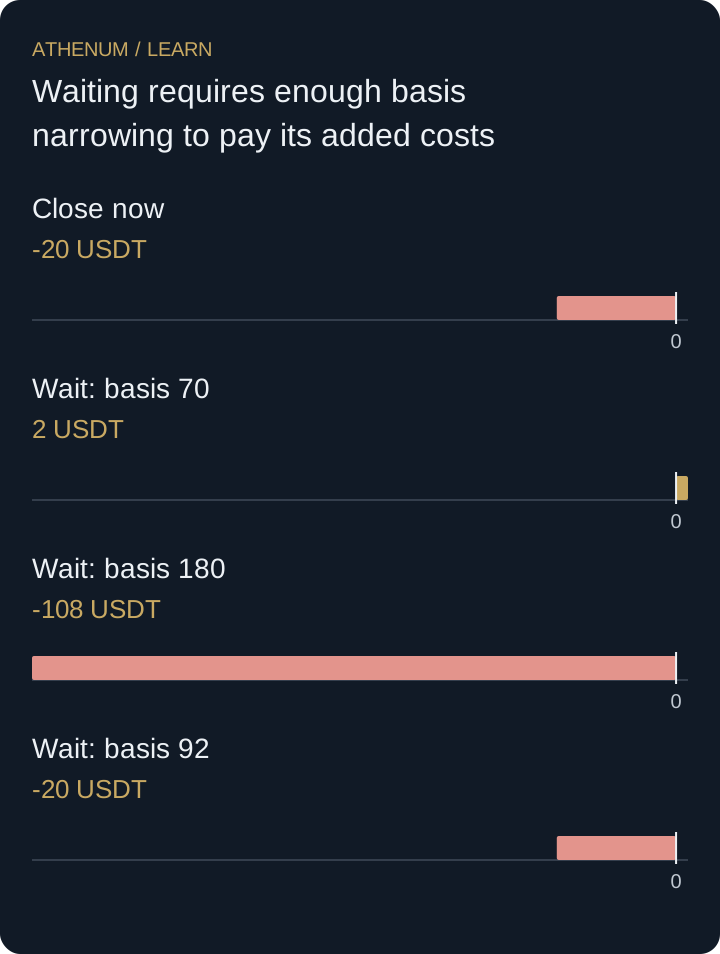
Waiting requires enough basis narrowing to pay its added costs
At 12:00 UTC, a fictional matched one-unit hedge has spot valued at 50,000 USDT and its linear perpetual at 50,120, so current basis is 120. Both legs can be closed and the loan repaid well before the next settlement for an all-in exit cost of 20 USDT relative to these reference valuations. Closing now therefore changes wealth by −20; proceeds then remain in USDT with no interest through the common 16:10 horizon. Earlier funding receipts of 80 USDT are already common to both branches.
The alternative holds both legs through 16:00 and closes at 16:10. For the stated scenarios, assume settled funding of −0.040% on 50,000 USDT of eligible short notional, giving a 20 USDT payment; additional borrowing costs 3 and the all-in later exit costs 25. These are scenario inputs, not forecasts or current fee quotes. If exit basis narrows to 70, incremental result is (120 − 70) − 20 − 3 − 25 = +2 USDT, which is 22 better than closing now. If basis widens to 180, result is −108, which is 88 worse.
Holding and closing now tie when 120 − exit basis − 20 − 3 − 25 = −20, giving an exit basis of 92 USDT. Thus the wait branch needs basis narrowing of 28 USDT just to tie under these assumptions. More narrowing helps it; less narrowing hurts it. The prior 80 USDT receipt does not appear in this threshold because it is already earned in both alternatives.
| Alternative | Future price P&L | Future funding | Borrow cost | Exit cost | Incremental result |
|---|---|---|---|---|---|
| Close now | 0 | 0 | 0 | 20 | −20 |
| Wait; exit basis 70 | +50 | −20 | 3 | 25 | +2 |
| Wait; exit basis 180 | −60 | −20 | 3 | 25 | −108 |
| Wait; tie at basis 92 | +28 | −20 | 3 | 25 | −20 |
 Open full-size diagram
- Close now: -20 USDT
- Wait: basis 70: 2 USDT
- Wait: basis 180: -108 USDT
- Wait: basis 92: -20 USDT
Already-earned funding cannot pay away the opportunity cost
Saying that the next 20 USDT payment is covered by the earlier 80 does not compare the choices. Closing now also retains that earlier receipt. Similarly, an unfilled exit order cannot be credited with avoiding funding. Keep the common past, feasible execution times and remaining obligations explicit, then recompute if the rate, borrowing cost or exit liquidity changes.
Before acting
- Set a common decision valuation and comparison horizon.
- Exclude already-settled cash flows from the difference between branches.
- Confirm that each exit and repayment sequence is feasible.
- Include future basis P&L, signed funding, borrowing and all exit costs.
- Solve the break-even basis and test adverse scenarios without invented probabilities.
Check your understanding
Keep the example unchanged except that the wait branch's settled funding payment is 40 USDT instead of 20. What exit basis now ties closing immediately, and how much better or worse is waiting if exit basis still reaches 70?
Show the explained answer
The wait result becomes 120 − exit basis − 40 − 3 − 25 = 52 − exit basis. Setting it equal to the close-now result of −20 gives an exit basis of 72 USDT. If basis reaches 70, waiting produces −18, which is 2 USDT better than −20. Waiting can be the better of two negative incremental outcomes; that comparison does not mean the full trade is profitable or that the scenario will occur.