Funding rate research: reconcile payments and hedges
Explain funding forecast errors, reconstruct changed settlement schedules, attribute OI-weighted rates and calculate borrowing and hedge-exit scenarios.
What you will practise
Build an auditable funding ledger and separate changes in rates, exposure, market weights and future carrying costs before comparing hedge decisions.
Before you start
- Complete Funding and basis, including the full spot–perpetual ledger.
- Understand linear contract notional, signed cash flows, basis points and open-interest units.
Course outline
- 1
Funding forecast vs payment: explain the rate and exposure gap
A 30 USDT funding estimate became a 12 USDT receipt. Separate the rate change from the exposure change and reconcile the account's actual funding entry.
9 minIn short: A funding payment differs from its forecast when the settled rate, the eligible notional or both change. With s = +1 for a short and −1 for a long, rate effect = s × N0 × (r1 − r0) and exposure effect = s × (N1 − N0) × r1; they sum to the gap.
- 2
Funding interval changes: rebuild the actual settlement ledger
Reconstruct a holding window across an 8-hour-to-hourly funding change. Match effective schedules, eligible positions, settled rates and posted payments.
8 minIn short: After a switch from eight-hour to hourly funding, list each settlement timestamp under the schedule version in force, attach the eligible notional and settled rate, and sum the signed payments. Multiplying the entry-time rate by the old settlement count misses events; applying today's interval to past windows invents them.
- 3
OI-weighted funding: separate rate changes from changing weights
Both venue rates fell, yet the OI-weighted index rose 1.4 basis points. Separate the rate effect from the weight effect on a consistent venue panel.
9 minIn short: An OI-weighted funding index R = Σ(w × r) can rise while every venue's rate falls if weight shifts to higher-rate venues. Split R1 − R0 into a rate effect, Σ[w0 × (r1 − r0)], and a weight effect, Σ[(w1 − w0) × r1]: −1.0 + 2.4 = +1.4 basis points.
- 4
Funding minus borrow costs: account for rate resets and repayment
Calculate net carry from actual funding and a changing loan balance. Include hourly rate resets, partial repayment and interest after the trade closes.
9 minIn short: Net carry = funding received − funding paid − loan interest, in one currency and window. Charge interest per billing period on the actual interest-bearing balance at that period's rate, and keep the loan ledger open until repayment is confirmed, not until the trade closes. Repaid principal is not an expense.
- 5
Funding turns negative: compare holding a hedge with closing it
A negative funding rate does not decide the exit alone. Compare holding and closing a spot–perp hedge from the decision time, ignoring funding already earned.
10 minIn short: Compare holding and closing from the decision time, excluding funding already received because both branches keep it. Waiting yields current basis − exit basis + signed future funding − borrowing − exit costs; in the example, basis must narrow from 120 to 92 just to tie closing now.
Calculators used in this course
Related courses
- Funding rates and basis trades: costs, crowding and carryCalculate actual funding cash flows, compare intervals fairly and evaluate two-leg or settlement strategies after costs and margin risk.
- Open interest data: audit quality before interpreting itFive original data audits covering account counts, venue coverage, record availability, volume consistency and weighted holder ratios.
- Crypto margin and collateral: reconcile account exposureWork through inverse P&L, shared-equity stress, conditional collateral deposits, maintenance deductions and marginal collateral bands.
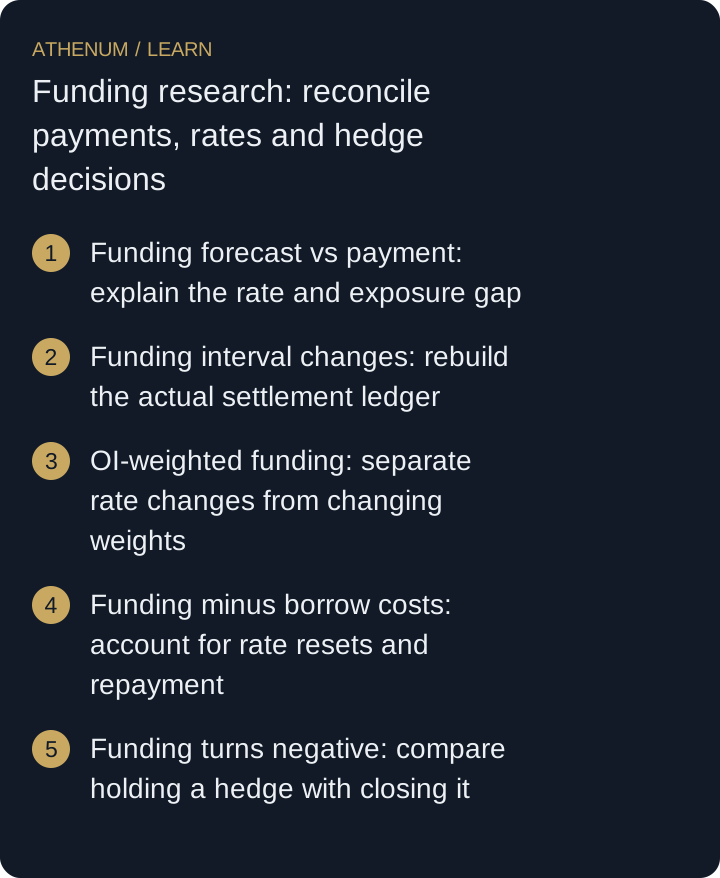 Open full-size diagram
- Funding forecast vs payment: explain the rate and exposure gap
- Funding interval changes: rebuild the actual settlement ledger
- OI-weighted funding: separate rate changes from changing weights
- Funding minus borrow costs: account for rate resets and repayment
- Funding turns negative: compare holding a hedge with closing it
Educational material. Examples do not establish a profitable strategy. Trading costs, gaps and liquidation can produce losses beyond a planned stop.