Funding research: reconcile payments, rates and hedge decisions · 4 / 5
Funding minus borrow costs: account for rate resets and repayment
Receiving funding does not establish positive carry when another leg is financed by a loan. The interest-bearing amount can change after a partial repayment, the rate can reset, and the liability may survive the trade's closing fill. Build the loan ledger independently, then combine its interest charges with funding in the same currency and window. The end of a position and the end of a loan are separate events.
Athenum9 minUpdated:
Follow the interest-bearing liability through each reset
For each billable period, record its boundaries, interest-bearing balance, applicable rate, resulting charge and repayment evidence. Bybit documents floating borrowing rates that update hourly. Its borrow-history schema includes the hourly rate, interest-bearing size and charged interest. Those records allow a more precise audit than multiplying the first displayed rate by total elapsed hours.
The product's billing rules still control the calculation. Bybit distinguishes flexible-term spot and derivative liabilities; their initial and recurring interest treatment differs, and unpaid interest can itself become a liability. A fixed-term loan has different early-repayment economics. Identify the actual product before deciding whether to prorate a partial period, capitalize interest, apply an exemption or stop accrual. A generic hourly formula does not replace these rules.
Combine cash flows without confusing financing and profit
For one currency, a narrowly defined net-carry subtotal is funding received minus funding paid minus loan interest. Returning principal reduces both cash and debt; it is not a trading expense equal to the principal repaid. Trading fees, execution losses, repayment conversion fees, price P&L and other financing items belong in the complete strategy ledger. Keep those categories separate so that a positive carry subtotal is not reported as total profit.
If interest is owed in an asset while funding arrives in a stablecoin, retain both original currency amounts and a stated conversion valuation. Do not subtract token units directly from USDT. Track the liability until repayment is confirmed under the relevant loan terms. Selling the financed asset or submitting a repayment request does not, by itself, establish that no further interest will be charged.
A changing four-hour loan costs 2.10 USDT
This original hypothetical loan has four complete billable hours, H1 through H4, with the balances and effective rates below. Interest is paid from separate cash each hour, so none is capitalized. A confirmed 10,000 USDT principal repayment occurs between H2 and H3. The associated spot and perpetual positions both close after H3, but the remaining principal is only repaid after H4. The example specifies its billing periods; it does not model Bybit's partial first hour or an actual account's repayment restrictions.
Interest is 20,000 × 0.00002 + 20,000 × 0.00003 + 10,000 × 0.00005 + 10,000 × 0.00006 = 2.10 USDT. Confirmed funding receipts of 2.40 and 1.80 USDT during H2 and H3 total 4.20, giving net carry of 4.20 − 2.10 = 2.10 USDT. There is no funding after the positions close, but the outstanding loan still contributes the H4 interest charge. Freezing the rate at H1 would produce only 1.20 USDT of interest and overstate carry by 0.90.
| Billable period | Interest-bearing principal | Hourly rate | Interest charge | Liability state |
|---|---|---|---|---|
| H1 | 20,000 | 0.002% | 0.40 | Initial principal outstanding |
| H2 | 20,000 | 0.003% | 0.60 | Partial repayment follows H2 |
| H3 | 10,000 | 0.005% | 0.50 | Both trading legs close after H3 |
| H4 | 10,000 | 0.006% | 0.60 | Final repayment follows H4 |
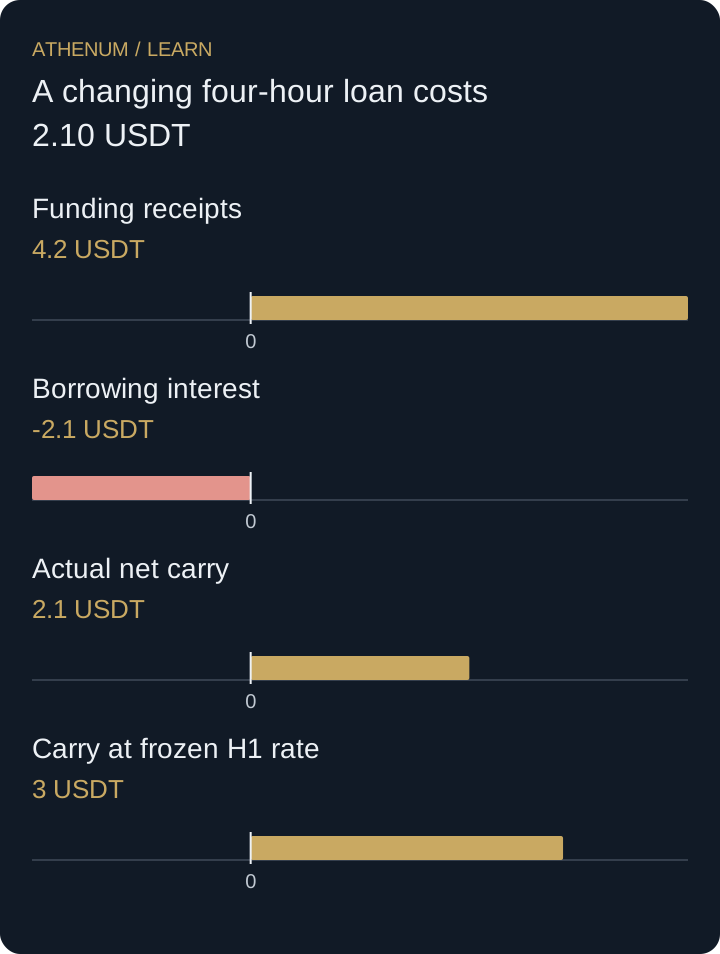 Open full-size diagram
- Funding receipts: 4.2 USDT
- Borrowing interest: -2.1 USDT
- Actual net carry: 2.1 USDT
- Carry at frozen H1 rate: 3 USDT
A closed hedge can leave an open loan
Stopping this ledger after H3 would omit 0.60 USDT and report 2.70 USDT of carry. The omission comes from using the trading exit as the loan's endpoint. Confirm repayment and check subsequent interest records. Also do not carry the example's no-capitalization assumption into a real account where unpaid interest increases the interest-bearing balance.
Before acting
- Identify loan type, currency and the actual billing boundaries.
- Use each period's interest-bearing amount and effective rate.
- Account for partial repayments and any capitalized interest.
- Extend the ledger through confirmed final repayment.
- Label funding less interest as net carry, with other P&L recorded separately.
Check your understanding
The scheduled partial repayment fails, so the example's principal stays at 20,000 USDT in H3 and H4. All four rates, separate interest payments and the 4.20 USDT funding total are unchanged. What are total interest and net carry?
Show the explained answer
H1 and H2 still cost 0.40 and 0.60 USDT. H3 now costs 20,000 × 0.00005 = 1.00, and H4 costs 20,000 × 0.00006 = 1.20. Total interest is 3.20 USDT, leaving 4.20 − 3.20 = 1.00 USDT of net carry. A repayment instruction that did not reduce the liability cannot justify using the lower 10,000 balance. Returning the 20,000 principal later is a financing cash flow, not another 20,000 of interest expense.