Funding research: reconcile payments, rates and hedge decisions · 3 / 5
OI-weighted funding: separate rate changes from changing weights
An OI-weighted funding index can rise even when every included venue lowers its rate. More weight may have moved toward the venue with the higher remaining rate. Before describing the change as broad funding pressure, separate what happened inside each constituent from how the index redistributed its weights. This is a measurable composition effect, not evidence that the individual rates rose.
Athenum9 minUpdated:
Define the index you are actually studying
For this lesson, define a research index R = Σ(w × r), where each weight w equals a constituent's compatible open-interest notional divided by the panel's total. The weights sum to one. Every rate uses the same interval and meaning: do not mix a next-settlement forecast with another venue's last settled rate. This is an explicitly defined teaching index, not a claim about the undisclosed calculation behind any particular dashboard.
Use the same constituents at both observations and a common valuation currency and OI convention. Bybit's current documentation distinguishes both-side from single-side OI and gives different raw units for linear and inverse instruments. Normalize before forming weights. Uniformly doubling every constituent cancels in a ratio; doubling only one does not. A venue disappearing from the feed is a coverage change to investigate before applying this constant-panel decomposition.
Hold weights fixed, then change the composition
Let old weights and rates be w0 and r0, and new values be w1 and r1. Define the rate effect as Σ[w0 × (r1 − r0)]. Define the weight effect as Σ[(w1 − w0) × r1]. Their sum is exactly R1 − R0. This rate-first ordering places the interaction in the weight effect. State that choice; it is an accounting attribution, not proof that a change in OI caused a change in funding.
Keep the output unit explicit. One basis point is 0.01 percentage point, so a rate of 0.018% is 1.8 basis points. An index change of 1.4 basis points means 0.014 percentage point, not a 1.4% funding rate. The index also is not an account payment: the account has its own positions, eligible settlements and rates. Weight changes may reflect price valuation as well as changes in contract quantity.
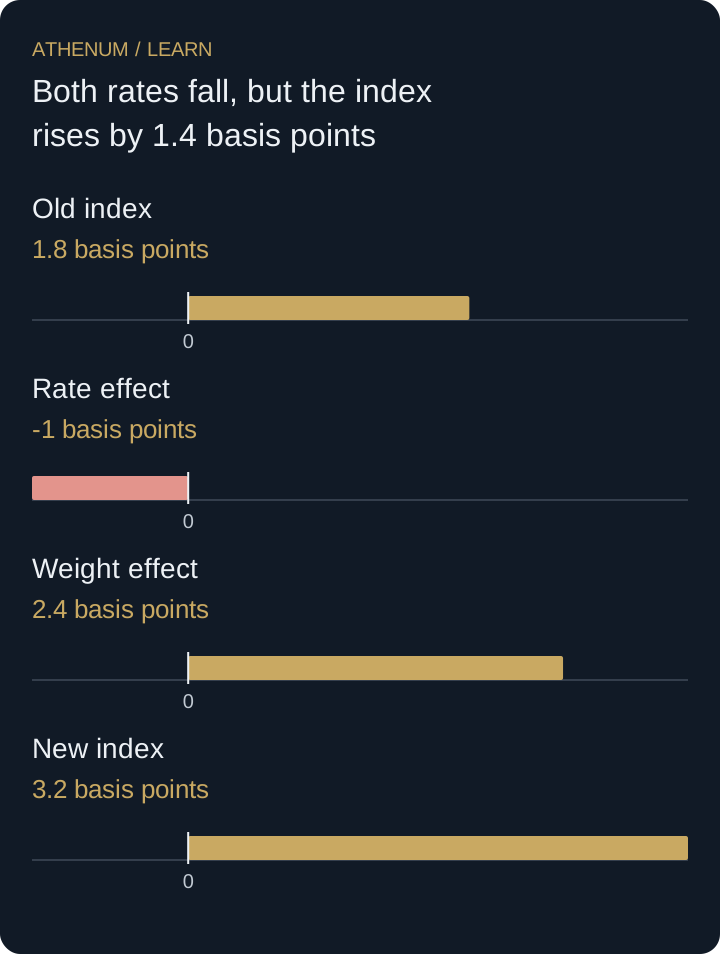
Both rates fall, but the index rises by 1.4 basis points
Use a fictional two-venue panel for the same underlying and the same eight-hour forecast horizon. The OI amounts below have already been normalized to compatible single-side USDT notionals. Venue A's weight falls from 80% to 20%; venue B's rises from 20% to 80%. A's rate falls from 1 to 0 basis points, and B's falls from 5 to 4. The total normalized panel OI remains 100 million USDT at each observation.
The old index is 0.8 × 1 + 0.2 × 5 = 1.8 basis points. Keeping old weights with new rates gives 0.8 × 0 + 0.2 × 4 = 0.8. The rate effect is therefore −1.0 basis point. New weights produce 0.2 × 0 + 0.8 × 4 = 3.2; the weight effect is +2.4. Together, −1.0 + 2.4 = +1.4, matching 3.2 − 1.8. The aggregate rose because of the composition effect in this chosen attribution, despite both constituent rates falling.
| Venue | Old OI (million USDT) | New OI (million USDT) | Old rate (bp) | New rate (bp) |
|---|---|---|---|---|
| A | 80 | 20 | 1 | 0 |
| B | 20 | 80 | 5 | 4 |
 Open full-size diagram
- Old index: 1.8 basis points
- Rate effect: -1 basis points
- Weight effect: 2.4 basis points
- New index: 3.2 basis points
A higher index does not mean most venues increased their rates
Reporting only the aggregate would reverse the constituent-level story in this example. Report the rate and weight contributions together, and keep a coverage check beside them. If a new venue enters, a quote-currency conversion changes, or old OI is paired with a fresh rate, first fix or separately label that comparability problem. A tidy decomposition of incompatible inputs remains an unreliable explanation.
Before acting
- Define rate type, common horizon and the exact weighting formula.
- Use a consistent constituent panel and synchronized observations.
- Normalize OI units, valuation currency and side convention.
- Calculate the rate effect at old weights and the weight effect at new rates.
- Check that both effects sum to the index change in basis points.
Check your understanding
Two venues start with weights 50% and 50% and rates 2 and 6 basis points. Later their weights are 25% and 75%, and their rates are 1 and 5 basis points. Calculate both index levels and the rate-first effects. Does an unchanged index mean the constituents were unchanged?
Show the explained answer
The old index is 0.5 × 2 + 0.5 × 6 = 4 basis points. The new index is 0.25 × 1 + 0.75 × 5 = 4. The rate effect is 0.5 × (1 − 2) + 0.5 × (5 − 6) = −1. The weight effect is (0.25 − 0.5) × 1 + (0.75 − 0.5) × 5 = +1. They cancel. Both rates fell and the weights changed, even though the aggregate stayed at four basis points.