Funding research: reconcile payments, rates and hedge decisions · 1 / 5
Funding forecast vs payment: explain the rate and exposure gap
A funding estimate of 30 USDT followed by a payment of 12 USDT does not tell you which input changed. The rate may have fallen, the eligible position may have shrunk, or its settlement valuation may differ. Start with two frozen records: what was known when the estimate was made and what actually settled. Then explain the difference with a bridge that adds back to the observed payment.
Athenum9 minUpdated:
Keep the forecast, settlement and account entry separate
A live rate can change before settlement. Bybit's funding-history endpoint provides dated settled rates; it does not reconstruct every earlier forecast. Preserve the forecast's observation time, target settlement time, symbol, position side and assumed notional. Match the eventual payment to that same settlement, rather than comparing it with whichever next-rate estimate happens to be visible later.
For this lesson's linear contract, let N0 be forecast notional and N1 be eligible settlement notional. Let r0 and r1 be the corresponding market rates expressed as decimals. Define s as +1 for a short and −1 for a long, using the convention that a positive rate transfers funding from longs to shorts. The forecast is s × N0 × r0; settled funding is s × N1 × r1. Settlement notional includes both eligible quantity and the applicable valuation price. An inverse contract requires its own position-value formula.
Build a bridge with an explicit order
First change the rate while holding the old notional fixed: rate effect = s × N0 × (r1 − r0). Then change notional at the settled rate: exposure effect = s × (N1 − N0) × r1. These two effects exactly equal settled funding minus forecast funding. The ordering allocates their interaction to the exposure effect. Reversing the order gives another valid allocation, so name the convention instead of presenting it as a unique causal explanation.
Check the resulting funding amount against the account record, not just the wallet's total change. Bybit's transaction log treats positive funding as a receipt and records cashFlow, funding and trading fee separately: change = cashFlow + funding − fee. Other record types can use different signs. Preserve the source field definition before translating a fee into money received or paid. A delayed or mismatched record is an unresolved reconciliation, not automatically a zero payment.
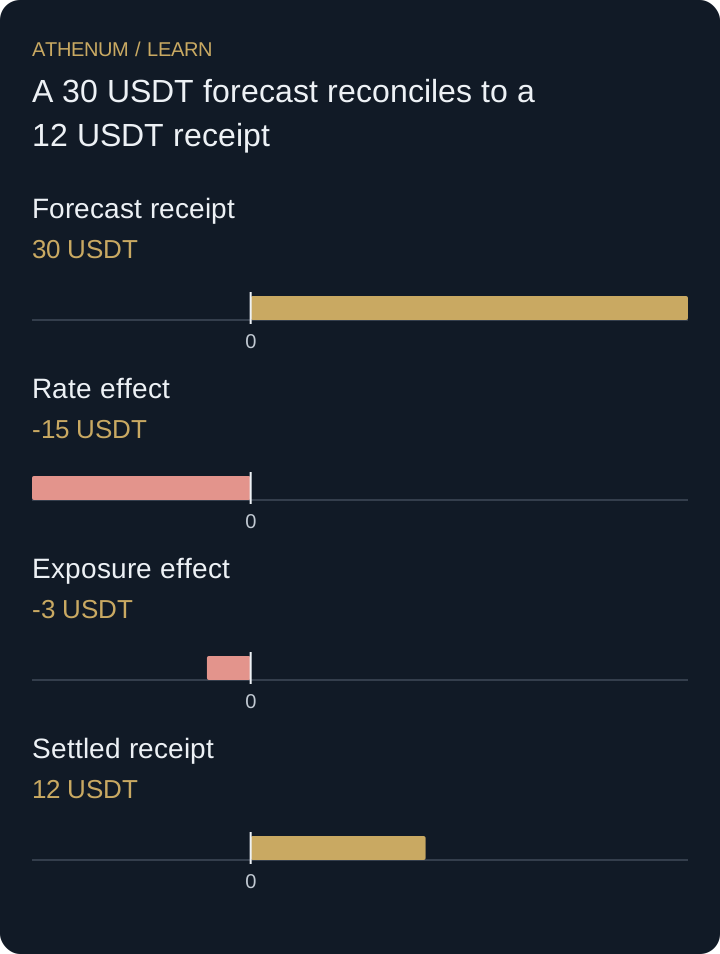
A 30 USDT forecast reconciles to a 12 USDT receipt
This original fictional ledger concerns one short linear position and one settlement. Its saved forecast uses 100,000 USDT notional and +0.030%, producing an expected receipt of 30 USDT. Before settlement the position is reduced; the verified eligible notional is 80,000 USDT and the settled market rate is +0.015%. Its funding receipt is therefore 12 USDT. All figures are illustrative, not downloaded account records.
The rate effect is 100,000 × (0.00015 − 0.00030) = −15 USDT. The exposure effect is (80,000 − 100,000) × 0.00015 = −3 USDT. Thus 30 − 15 − 3 = 12. The table's middle row is an accounting counterfactual, not an additional settlement. Across the reconciled account window, suppose cashFlow totals +25 USDT, funding is +12 and trading fees are +2. The cash change is +35 USDT, but only 12 of that is funding. Neither number is a complete strategy return without the other positions and costs.
| Stage | Notional (USDT) | Market rate | Funding (USDT) |
|---|---|---|---|
| Saved forecast | 100,000 | +0.030% | +30 |
| Settled rate, old notional | 100,000 | +0.015% | +15 |
| Eligible settlement | 80,000 | +0.015% | +12 |
 Open full-size diagram
- Forecast receipt: 30 USDT
- Rate effect: -15 USDT
- Exposure effect: -3 USDT
- Settled receipt: 12 USDT
Do not overwrite the forecast with the answer
Replacing the saved rate with the final settled rate makes the rate error disappear on paper. It also makes an earlier decision look better informed than it was. Keep both snapshots, and investigate any remaining difference after rounding, eligibility, valuation and sign conventions are checked. If the position changes side before settlement, split the exposure records; do not apply this constant-side bridge across a long-to-short reversal.
Before acting
- Match forecast and payment to the same instrument and settlement timestamp.
- Keep the original forecast rate and assumed notional.
- Use eligible settlement quantity and the contract's valuation rule.
- Declare the rate-first decomposition and verify that its effects add up.
- Reconcile the funding field separately from total account cash changes.
Check your understanding
A long forecasts funding using 50,000 USDT and +0.020%. It settles with 60,000 USDT and −0.010%. Using the rate-first bridge, find forecast funding, both effects and settled funding. If the same account window has cashFlow of −4 USDT and fees of +1 USDT, what is its cash change?
Show the explained answer
The long uses s = −1. Its forecast is −50,000 × 0.00020 = −10 USDT. The rate effect is −50,000 × (−0.00010 − 0.00020) = +15. The exposure effect is −(60,000 − 50,000) × (−0.00010) = +1. The settled receipt is −10 + 15 + 1 = +6 USDT, also equal to −60,000 × (−0.00010). Account cash changes by −4 + 6 − 1 = +1 USDT. A one-USDT cash increase therefore does not mean that funding was one USDT.