Execution mechanics: from intended orders to actual fills · 1 / 5
Round an executable quantity without increasing the risk budget
An order can fit a trading idea and still fail the instrument's trading rules. Quantity increments, price ticks and minimum notional are different constraints. A calculator's decimal output is a proposed size, not an executable instruction. The unit matters first: a quantity can denote coins, contracts or quote-currency spend. Read the instrument definition before multiplying quantity by price.
Athenum6 minUpdated:
From loss budget to permitted size
Start with a declared loss budget and a per-unit loss estimate. For a linear instrument, that estimate includes entry-to-invalidation distance plus assumed round-trip fees and adverse execution. This is a planning estimate, not a maximum possible loss: a gap or unavailable exit can exceed it. Divide the budget by the per-unit estimate, then round down to a permitted quantity step. Recalculate all constraints after rounding. Do not round up merely to make the exchange accept it.
Recompute after rounding a price
Price rounding needs its own check. Rounding a buy limit upward can worsen the maximum entry, while rounding a sell limit downward can worsen the minimum sale. A stop trigger also needs to fit the price grid; changing it changes risk. Recompute quantity from the final executable prices and costs. Store decimal or integer tick values rather than assuming binary floating-point output is an accepted tick.
A 50-USDT budget with a 0.25-unit step
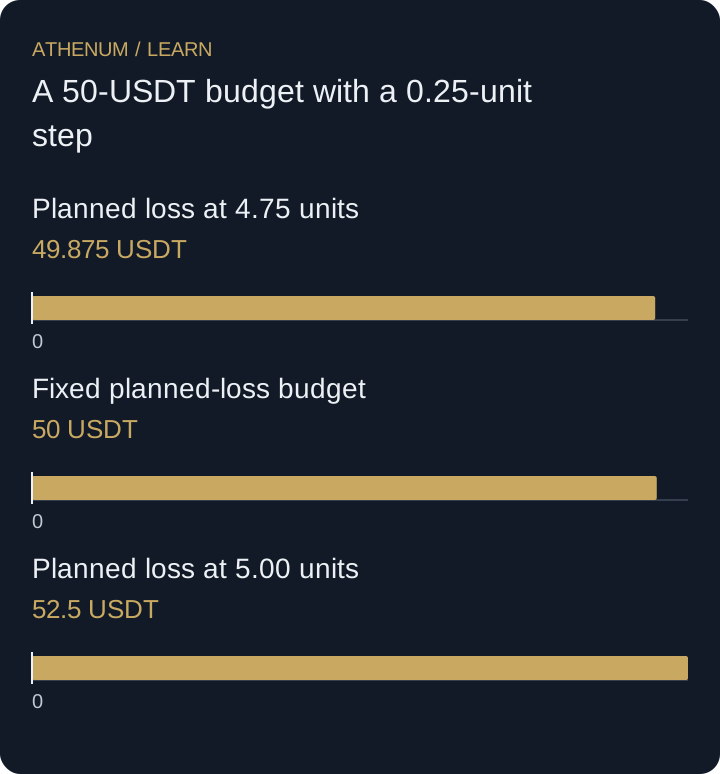
Consider a hypothetical linear order with entry 200 USDT, invalidation 190 USDT, and 0.50 USDT per unit reserved for fees and adverse execution. With a 50-USDT planned loss budget, the unconstrained quantity is 50 / 10.50 = 4.76190476 units. At a 0.25-unit step, the largest size that fits the budget is 4.75 units. Its planned loss is 49.875 USDT and its entry notional is 950 USDT. Quantity 5.00 would be accepted by the step rule but its planned loss would be 52.50 USDT.
| Candidate | Step valid? | Planned loss USDT | Entry notional USDT |
|---|---|---|---|
| 4.76190476 units | No | approximately 50.00 | approximately 952.38 |
| 4.75 units | Yes | 49.875 | 950.00 |
| 5.00 units | Yes | 52.50 | 1,000.00 |
 Open full-size diagram
- Planned loss at 4.75 units: 49.875 USDT
- Fixed planned-loss budget: 50 USDT
- Planned loss at 5.00 units: 52.5 USDT
A minimum order can make the trade infeasible
Now add a hypothetical 1,000-USDT minimum notional. The rounded-down order fails that constraint. The correct conclusion under the declared assumptions is that there is no feasible order. Raising quantity to 5.00 satisfies minimum notional but violates the risk budget. Moving the stop merely to fit the order also changes the original trading hypothesis. Record the rejection and consider another instrument or no trade; do not silently change the budget.
Before acting
- Read whether quantity means units, contracts or quote spend.
- Freeze the loss budget and per-unit cost assumptions.
- Round quantity down to the permitted step.
- Recheck minimum notional and all price/quantity constraints.
- Record no trade when no permitted quantity fits the original risk budget.
Check your understanding
With a 0.50-unit step, the same 50-USDT budget and no binding minimum notional, what is the largest permitted size?
Show the explained answer
The largest size is 4.50 units. Planned loss is 4.50 × 10.50 = 47.25 USDT. A five-unit order would risk 52.50 USDT. Leaving part of the budget unused preserves the original constraint.