Order execution mechanics: from orders to actual fills
Work through quantity rounding, maker queues, partial IOC exits, trigger sources and implementation shortfall with original ledgers and reconciled calculations.
What you will practise
Reconcile the intended trade with permitted order parameters, confirmed fills, fees and residual exposure.
Before you start
- Complete the risk and execution course.
- Understand linear position size, limit prices, fees and order-book depth.
Course outline
- 1
Round an executable quantity without increasing the risk budget
Check quantity steps, price ticks and minimum notional against a fixed risk budget. Learn when rounding leaves no order that fits the original risk.
6 minIn short: Divide the loss budget by the per-unit loss including fees and adverse execution, round down to the quantity step, then recheck price ticks and minimum notional. A 50 USDT budget at 10.50 USDT per unit gives 4.75 units at a 0.25 step; with a 1,000 USDT minimum notional, no order fits.
- 2
Reconstruct a maker queue before assuming a fill
A trade at your limit price does not prove your fill. Rebuild a FIFO queue from an event ledger: eight units join behind thirty; cancellations stay uncertain.
6 minIn short: A trade at your limit price does not prove a fill: under FIFO, quantity ahead of you fills first. An eight-unit offer behind 30 units filled only five units while 28 traded at its price. Your own order and fill reports establish executed size, not chart touches.
- 3
Reconcile an IOC partial fill and the exposure it leaves behind
Calculate an IOC exit's average fill, fees and remaining exposure. Seven units fill and three stay open: a cancelled remainder does not close the position.
6 minIn short: An IOC order cancels only its unfilled remainder; it does not close the position. A 10-unit reduce-only IOC sell limited at 99.80 fills 7 units averaging about 99.957 USDT, cancels 3 and leaves 3 units of the long open. Reconcile fills and position before another exit.
- 4
Align a stop trigger with the price series that actually activates it
Last trade, mark and index price can differ at the same moment. Compare all three triggers on one timeline and separate stop activation from execution.
6 minIn short: A stop triggers only when its selected source, last trade, mark or index price, crosses the threshold, and these can differ at the same moment. With one 100.00 USDT sell threshold, last trade crossed first, then mark, then index. Triggering activates an order; it does not guarantee the fill price.
- 5
Measure implementation shortfall against a declared decision benchmark
Count executed-price differences, fees and the opportunity cost of unfilled quantity. Reconcile decision and arrival benchmarks without double-counting delay.
6 minIn short: Implementation shortfall = executed-price difference from the decision benchmark + fees + price move on unfilled quantity to a declared horizon. Buying 7 of 10 intended units gives 1.00 + 0.35050 + 1.20 = 2.55050 USDT. Average fill price alone ignores delay and the unfilled remainder.
- 6
Reconcile unique executions when order updates repeat
Calculate remaining exposure and fees from an execution ledger. Handle repeated delivery and fill/cancel races without counting the same trade twice.
8 minIn short: Count each execution ID once and keep distinct partial fills of the same order; status messages and cumulative snapshots are not extra trades. Unique fills of 2 and 1 units close 3 of a 5-unit long even if one fill is delivered twice, leaving 2 units open.
Calculators used in this course
Related courses
- Position sizing and leverage: risk, stops and feesSize a position from invalidation, distinguish leverage from exposure and test whether a setup survives real trading costs.
- Order book liquidity and liquidation heatmapsIdentify what a heatmap measures, reconcile walls with trades, calculate slippage and evaluate sweeps without assuming a guaranteed reversal.
- Trade management: partial exits, MFE/MAE and time stopsCalculate partial-exit R, cost-adjusted break-even, observed MFE and MAE, add-on risk and time stops using complete hypothetical trading ledgers.
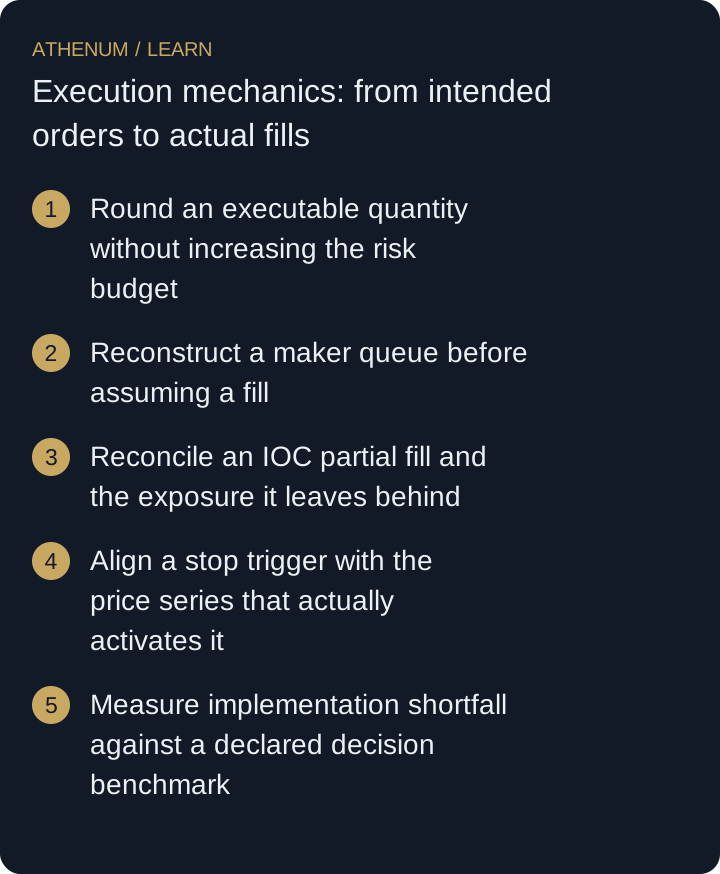 Open full-size diagram
- Round an executable quantity without increasing the risk budget
- Reconstruct a maker queue before assuming a fill
- Reconcile an IOC partial fill and the exposure it leaves behind
- Align a stop trigger with the price series that actually activates it
- Measure implementation shortfall against a declared decision benchmark
- Reconcile unique executions when order updates repeat
Educational material. Examples do not establish a profitable strategy. Trading costs, gaps and liquidation can produce losses beyond a planned stop.