Execution mechanics: from intended orders to actual fills · 5 / 5
Measure implementation shortfall against a declared decision benchmark
Average fill price answers where executed quantity traded. It does not by itself measure the cost of implementing the original decision. An attractive fill average can coexist with a costly delay or a large unfilled remainder. To evaluate an execution method, state the intended quantity, decision price, observation horizon and treatment of unfilled quantity before seeing the result.
Athenum6 minUpdated:
Choose the counterfactual before the outcome
For a hypothetical cash buy, compare the implemented portfolio with buying the entire intended quantity instantly at the decision benchmark. The benchmark is a counterfactual measurement tool, not a claim that an immediate frictionless fill was available. An unrealistically large intended quantity can make this comparison misleading; the quantity must be credible relative to executable liquidity. With no cash interest, funding or other cash flows over the short measurement interval, shortfall equals executed-price difference plus explicit fees plus the benchmark-relative price move on unfilled quantity. For sells, signs must be derived consistently instead of reusing a buy formula unchanged.
Reconcile an arrival-price decomposition
Now suppose the arrival benchmark, measured when the order could first enter the venue, was 100.15. The seven fills are 0.05 USDT cheaper in total than buying seven units at arrival. Calling that a 0.05-USDT execution saving is defensible only with the arrival benchmark clearly named. It does not erase the earlier decision delay. The same total can be decomposed into 1.50 USDT of delay on all ten intended units, −0.05 USDT of executed-price difference from arrival, 0.75 USDT of post-arrival opportunity cost on the unfilled three, and 0.35050 USDT of fees. These sum to the same 2.55050 USDT. Do not add both decompositions together and double-count delay.
Ten intended units, seven fills, 2.55050 USDT of shortfall
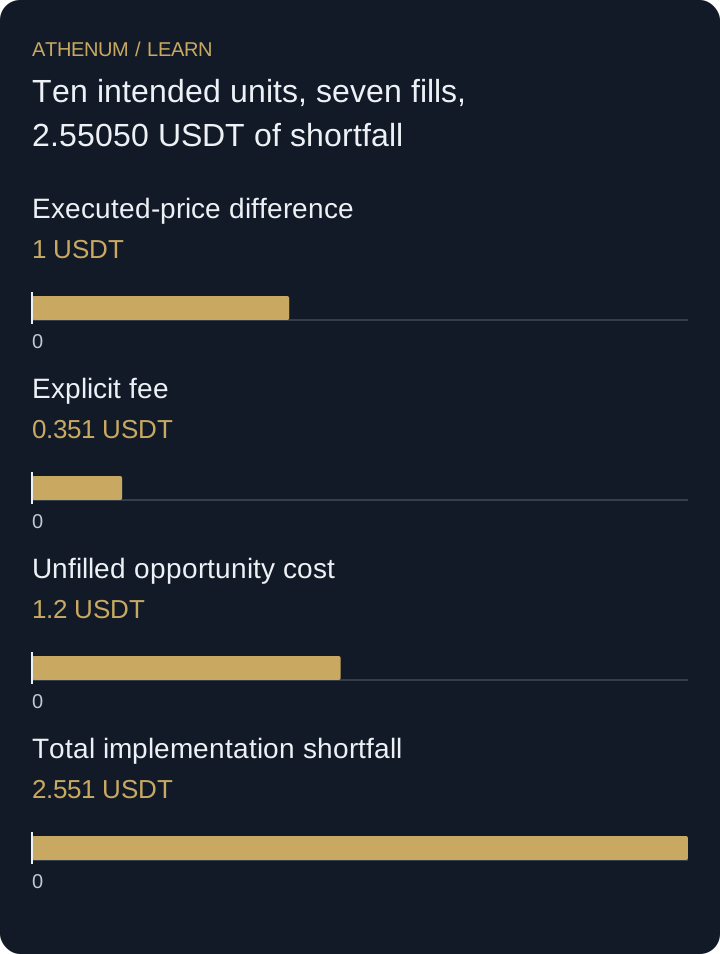
Suppose the decision is to buy ten units at a benchmark of 100.00 USDT. Four fill at 100.10 and three at 100.20; three remain unfilled. At the declared evaluation time, price is 100.40. Use a hypothetical fee of 0.05% of executed notional. Executed notional is 400.40 + 300.60 = 701.00 USDT. The seven fills cost 1.00 USDT more than seven units at the decision benchmark; the fee is 0.35050 USDT. The unfilled three units miss a 0.40-USDT rise, giving 1.20 USDT of opportunity cost. Total implementation shortfall is 2.55050 USDT against this benchmark and horizon.
| Component | Calculation | Cost USDT |
|---|---|---|
| Executed-price difference | 701.00 − 7 × 100.00 | 1.00000 |
| Explicit execution fee | 701.00 × 0.0005 | 0.35050 |
| Unfilled opportunity cost | 3 × (100.40 − 100.00) | 1.20000 |
| Total | Sum of the three distinct components | 2.55050 |
 Open full-size diagram
- Executed-price difference: 1 USDT
- Explicit fee: 0.351 USDT
- Unfilled opportunity cost: 1.2 USDT
- Total implementation shortfall: 2.551 USDT
Do not select only orders that filled
An unfilled order can have negative opportunity cost when price falls. That is a benchmark-relative benefit, not realized profit on units you never owned. A method that looks good only after removing unfilled or rejected orders is selected on its own outcomes. Keep all decisions, including abandoned orders, and use the same horizon across methods. Separate price impact, timing and market movement only when the data support that attribution; the total alone does not identify cause.
Before acting
- Record intended quantity and decision benchmark before submission.
- Name the evaluation horizon for unfilled quantity.
- Count explicit fees once on actual fills.
- Keep decision and arrival decompositions consistent.
- Retain rejected, cancelled and unfilled decisions in the execution sample.
Check your understanding
With the same seven fills and fee, the evaluation price is 99.60. What is implementation shortfall, and does it equal trade profit?
Show the explained answer
Unfilled opportunity cost is 3 × (99.60 − 100.00) = −1.20 USDT. Total shortfall is 1.00 + 0.35050 − 1.20 = 0.15050 USDT. This compares the actual portfolio with the ten-unit benchmark; it is not realized profit or the P&L of the seven-unit position.