Orderflow measurement: resets, units and information timing · 5 / 5
Unknown trade sides: calculate honest bounds for volume delta
If part of a known trade population has an unknown aggressor side, forcing it into buys or sells creates false precision. Keep the unknown quantity and report the range of possible deltas. A bound that crosses zero cannot establish the net sign.
Athenum7 minUpdated:
Bound only the uncertainty you actually measured
Let B be known buyer-aggressor quantity, S known seller-aggressor quantity and U observed quantity whose side is unknown. Known delta is B − S. If every unknown execution is either buyer- or seller-initiated under the chosen convention, total delta lies between B − S − U and B − S + U.
This is a deterministic bound for an observed population. It is not a confidence interval and assigns no probability to points inside it. If entire trades are missing and their quantity is unknown, the same finite interval does not bound the full market. Report the coverage problem separately.
Use uncertainty as a decision input
A positive lower bound establishes positive delta within the declared observed set. A negative upper bound establishes negative delta. When the interval crosses zero, the sign is unresolved. A strategy can explicitly skip such intervals or test a rule requiring a minimum bound, but the rule must be fixed before examining outcomes.
Classification completeness also differs from economic relevance. A perfectly classified feed from one small venue need not represent the whole market. Do not replace missing venues with zero, and do not claim that identifying net aggression identifies open positions or future price direction.
Worked example: +15 known delta has an unresolved total sign
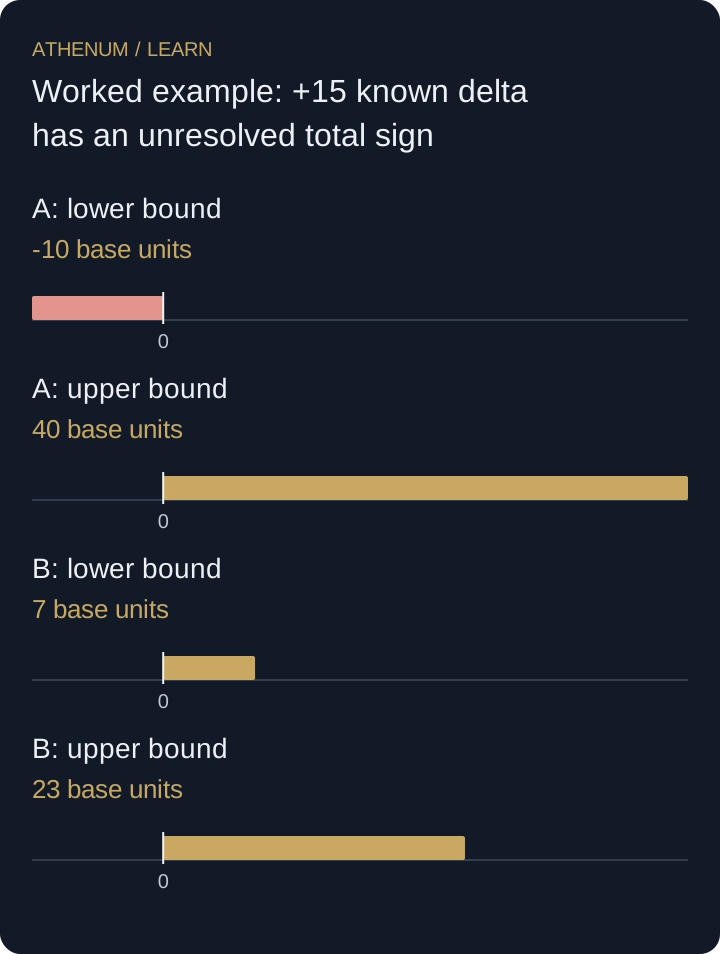
In an original hypothetical interval, known buys total 70 units, known sells 55 and unknown-side executions 25. Known delta is +15, but the feasible total range is 15 − 25 = −10 to 15 + 25 = +40. Observed total quantity is 150, with 83.333% classified.
If the same known buys and sells had only 8 unknown units, the interval would be +7 to +23. Its sign would then be positive for that observed set. The smaller interval says classification uncertainty is lower; it does not say missing venues are irrelevant or the next price move must rise.
| Quantity or bound | Case A | Case B |
|---|---|---|
| Known buys | 70 | 70 |
| Known sells | 55 | 55 |
| Unknown side | 25 | 8 |
| Lower delta bound | −10 | +7 |
| Upper delta bound | +40 | +23 |
 Open full-size diagram
- A: lower bound: -10 base units
- A: upper bound: 40 base units
- B: lower bound: 7 base units
- B: upper bound: 23 base units
Zero-filling unknown side quietly changes the claim
Assigning unknown-side trades zero contribution reproduces known delta, but it does not recover total delta. Label that number as classified-only and show its coverage. Dropping unknown records from both the numerator and denominator can make completeness look artificially perfect and conceal the ambiguity that matters to the reader.
Before acting
- Preserve unknown-side quantity separately.
- Calculate lower and upper feasible deltas.
- State whether entire trades or venues may be missing.
- Keep deterministic bounds distinct from statistical confidence.
Check your understanding
Known buys are 48 units, known sells 40 and unknown-side quantity 12. Can the observed population be called net buyer-aggressive?
Show the explained answer
Known delta is +8, but total delta can range from 8 − 12 = −4 to 8 + 12 = +20. Because zero lies inside the range, the sign is unresolved. A claim of definite net buyer aggression would require additional classification information or a narrower population explicitly labeled as classified-only.