Indicator mechanics: reconstruct what the chart calculates · 4 / 5
Calculate Parabolic SAR before treating it as an active stop
A Parabolic SAR dot is an indicator state. To use it as protection, a trading policy must turn that value into a valid order and then track whether the order was accepted and executed.
Athenum7 minUpdated:
Calculate the state and its range constraint
In an established upward SAR state, the raw next value is previous SAR + previous acceleration factor × (previous extreme point − previous SAR). The upward extreme point is the highest high retained for the current upward run. New extremes can increase the acceleration factor up to its specified maximum.
A continuation update also respects the two preceding lows. For the worked case, there is no reversal and no new extreme. After the raw recurrence, cap the upward SAR at the lower of those two lows. Initialization, strict reversal comparisons and update ordering are part of the implementation; do not apply this continuation calculation blindly to a reversal bar.
Make the order policy explicit
Our hypothetical policy calculates from a completed bar, then requests an amendment for the next interval. Its old protective order remains active until the exchange confirms the replacement under the assumed amendment behavior. Record calculation, submission, confirmation, trigger and fill separately; real venues can have different amendment semantics.
A later dot on the other side of price can represent the indicator’s reversed state. It is not evidence that an earlier protective order existed at that new value. Likewise, a stop-market instruction can execute beyond its trigger, and a stop-limit instruction can leave exposure open. The recursive indicator alone does not implement those order decisions.
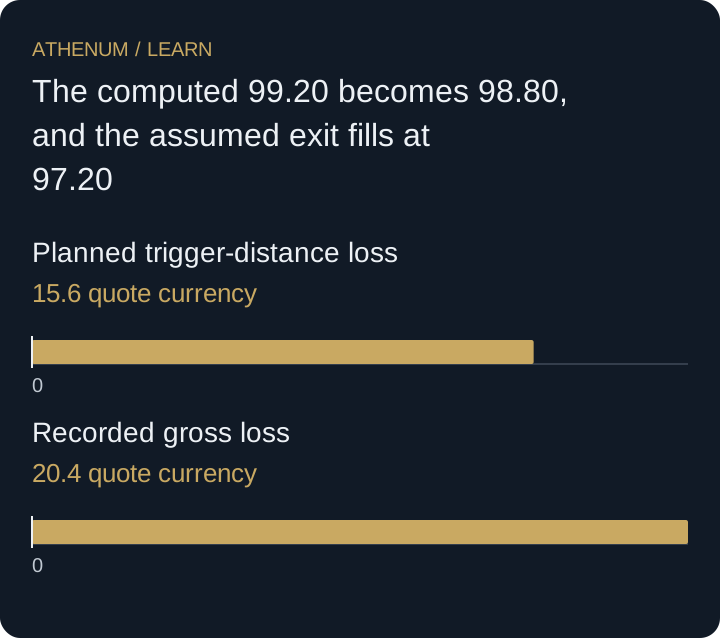
The computed 99.20 becomes 98.80, and the assumed exit fills at 97.20
Before the newly completed bar, upward SAR is 98, the extreme point is 108 and the acceleration factor is 0.12. The two preceding lows are 99 and 98.8. The new bar has low 100 and high 107: it neither crosses the raw SAR nor adds an extreme. Raw SAR = 98 + 0.12 × (108 − 98) = 99.20; the range constraint gives min(99.20, 99, 98.8) = 98.80.
After the close at 10:05:00 UTC, assume an amendment to 98.80 is confirmed at 10:05:00.100. In the next interval price gaps below the trigger; all three units are assumed to execute at 97.20. From entry 104, the planned trigger-distance loss was 3 × (104 − 98.80) = 15.60. The recorded gross loss is 3 × (104 − 97.20) = 20.40, before fees. These are invented fills, not a guarantee of how any venue would execute.
| Stage | Value | Meaning |
|---|---|---|
| Prior SAR | 98.00 | Indicator state before update |
| Raw continuation | 99.20 | Recurrence before range constraint |
| Constrained SAR | 98.80 | Value available after completed-bar calculation |
| Confirmed stop trigger | 98.80 | Accepted amendment for three units |
| Recorded exit | 97.20 | Assumed fill after a later gap |
 Open full-size diagram
- Planned trigger-distance loss: 15.6 quote currency
- Recorded gross loss: 20.4 quote currency
Increasing sensitivity does not remove the range constraint
With the same prior state but acceleration factor 0.20, the raw result is 100. The lower preceding low still caps the continuation value at 98.80 in this example. A higher parameter therefore need not produce a different final dot on every bar, and it does not improve order liquidity or guarantee a smaller loss.
Before acting
- Store direction, extreme point and acceleration state.
- Check continuation versus reversal before applying the example.
- Apply the preceding-range constraint.
- Verify the accepted order after each amendment.
- Reconcile remaining quantity and actual fills.
Check your understanding
Keep the previous SAR 98, extreme point 108 and factor 0.12, but change the preceding lows to 100 and 100.5. The new completed bar remains above 100.5 with no new extreme. What is the constrained continuation SAR?
Show the explained answer
The raw recurrence still gives 99.20. It is below both preceding lows, so the constrained value is min(99.20, 100, 100.5) = 99.20. This is the calculated indicator value; an accepted stop at that level still requires a separate order action.