Trading journal: costs, decisions and honest performance · 2 / 4
Trading journal review: separate rule adherence from profit
A profitable trade can violate the plan, and a losing trade can follow it exactly. Review rule adherence and financial outcome separately so one fortunate result does not rewrite the next decision.
Athenum7 minUpdated:
Make process quality observable
Use rules a reviewer can check: a required signal was available before entry, size stayed within the budget, the stop instruction was submitted, and the entry occurred within the permitted window. Record the evidence and timestamp. Labels such as confident, clean or high conviction are not substitutes for an observable condition.
Rule adherence is not proof that the strategy is good. A consistently followed losing rule still needs research and possible retirement. The process review asks whether the specified procedure was followed; the performance review asks what that procedure produced across an appropriately evaluated sample.
Review the decision with information available then
Hide the subsequent chart when initially scoring the entry process. Compare the recorded plan with the information and executable choices available at the time. Then reveal the outcome and reconcile actual fills and costs. This separation reduces the temptation to praise a violation only because it happened to win.
Keep the original rule version. If a rule was ambiguous, record the ambiguity rather than inventing a precise requirement after the result. A revised rule belongs to later decisions or a separately labeled research replay. Preserve losses, missed trades and nonqualifying signals as well as attractive screenshots.
Worked example: four trades, two independent review axes
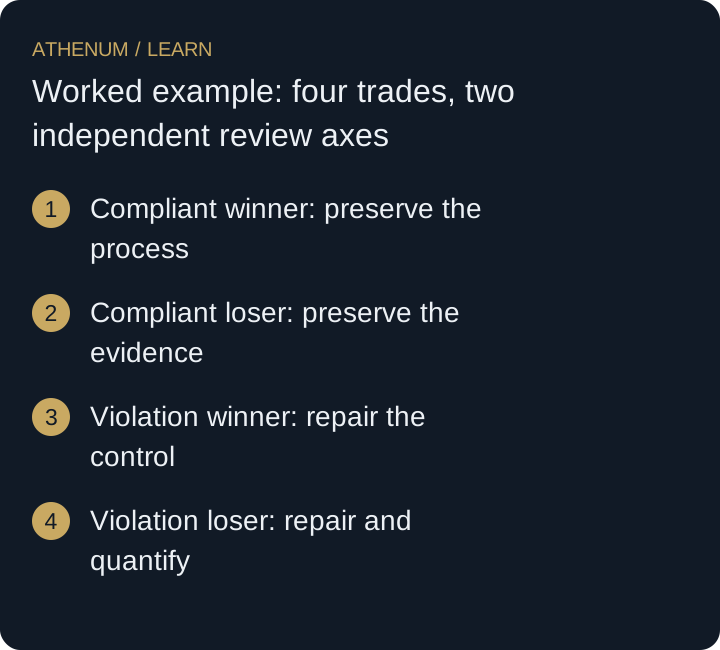
Four hypothetical net outcomes are +60, −40, +90 and −80 USDT. Trades A and B followed the recorded size and signal rules. Trade C exceeded its size cap but won; D entered before confirmation and lost. Total P&L is +30, yet half the decisions violated the plan.
The compliant subset earned +20 and the violating subset +10 in this tiny example. Neither subset is large enough to infer the expected value of compliance or violation. The useful finding is operational: C’s profit must not excuse oversizing, and B’s loss alone is not evidence that it was executed incorrectly.
| Trade | Rule adherence | Net outcome | Review action |
|---|---|---|---|
| A | Compliant | +60 | Retain evidence |
| B | Compliant | −40 | Retain valid losing example |
| C | Size cap violated | +90 | Investigate admission control |
| D | Confirmation violated | −80 | Investigate entry timing |
 Open full-size diagram
- Compliant winner: preserve the process
- Compliant loser: preserve the evidence
- Violation winner: repair the control
- Violation loser: repair and quantify
Do not turn discipline into a profitability claim
Discipline can make an experiment interpretable; it cannot create a positive edge in a bad strategy. If compliant trades keep losing after realistic costs across a valid evaluation window, reassess the hypothesis rather than blaming every loss on psychology. Conversely, one winning violation is not enough to adopt a new rule.
Before acting
- Write checkable conditions before entry.
- Score adherence using information available at the decision.
- Reconcile net outcome independently from the process score.
- Keep rule revisions and research conclusions separate from the original record.
Check your understanding
A trade returns +2R after entering before the required confirmation. Another loses −1R after following every rule. Which is compliant, and which result establishes the strategy’s edge?
Show the explained answer
The −1R trade is compliant and the +2R trade violates the specified confirmation rule. Neither individual result establishes an edge. Record the violation despite the profit, retain the valid loss, and assess the strategy on a complete, appropriately tested sample.