Audit open-interest data before interpreting it · 4 / 5
Open interest vs volume: check each interval for consistency
A passing daily total can conceal an impossible one-minute observation. Test the interval where a discrepancy occurs, under explicit counting, completeness and timing assumptions.
Athenum8 minUpdated:
An established accounting check, not an accusation
The volume-consistency bound is established in published research; it is not an Athenum invention. Our fictional ledger checks a conditional accounting constraint. It does not reproduce an empirical exchange study or establish current misconduct, insolvency or trader intent.
Declare the accounting model
Use one instrument, one venue, fixed contract units and one-sided OI. Count each matched traded contract once. Include every relevant execution exactly once and align the interval to the OI observations. For this exercise only, all outstanding-contract changes occur through the matched executions; there is no expiry, administrative cancellation, contract conversion or field revision. These assumptions must be checked before applying the calculation to a real feed. Dollar-valued OI with a changing conversion price does not satisfy the fixed-unit assumption merely because it has the same field name.
A passing endpoint total can hide the failed interval
The whole-window net change is only +10, while reported volume totals 30. Even the sum of absolute sampled OI changes is 12 + 8 + 6 = 26, below 30. Both whole-window checks pass although the second interval fails. Surplus volume in a different interval does not establish that the missing two executions occurred in the second interval. It might motivate investigating timestamp alignment; it does not justify silently moving trades until the test turns green.
For contrast, replace only the middle volume with eight. Every interval now has a feasible construction and the whole volume becomes 32. Passing still does not prove completeness: multiple opening and closing sequences can share the same endpoints, and an omitted transfer would not alter OI.
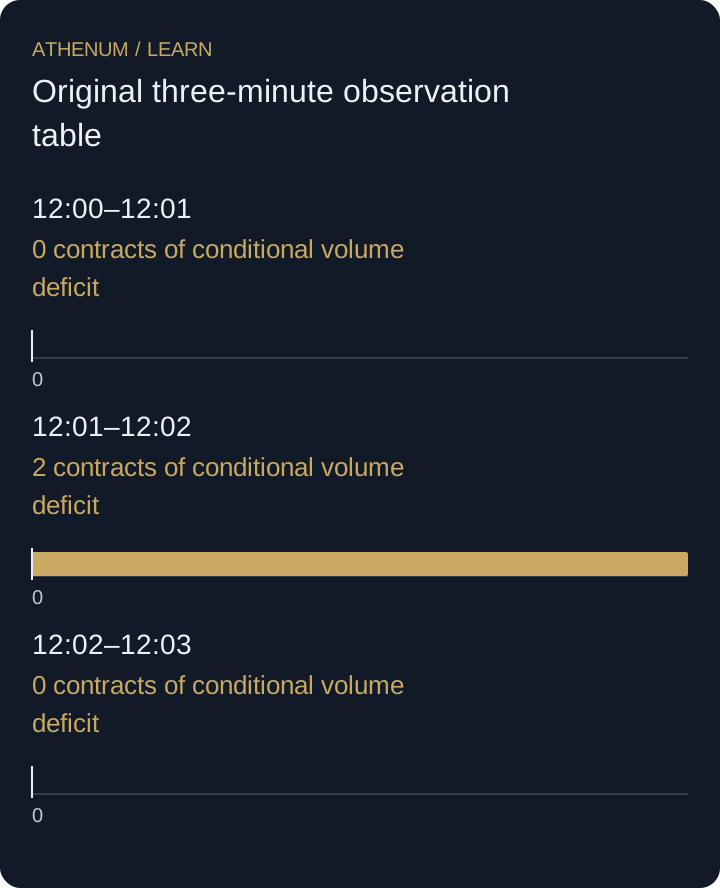
Original three-minute observation table
The first interval adds twelve pairs and reports fifteen traded contracts. It has enough volume to accommodate the change: for example, twelve new pairs and three transfers. The second removes eight pairs but reports only six traded contracts. Under the stated accounting model, six executions of one contract each cannot remove eight matched pairs. The deficit is two. The third interval adds six with nine traded contracts, again a feasible combination such as six new pairs and three transfers.
| Endpoint | One-sided OI | Traded contracts since previous endpoint |
|---|---|---|
| 12:00 | 100 | not applicable |
| 12:01 | 112 | 15 |
| 12:02 | 104 | 6 |
| 12:03 | 110 | 9 |
 Open full-size diagram
- 12:00–12:01: 0 contracts of conditional volume deficit
- 12:01–12:02: 2 contracts of conditional volume deficit
- 12:02–12:03: 0 contracts of conditional volume deficit
What the flag authorizes you to conclude
The observations and assumptions do not fit together. It does not identify which input is wrong. Check missing pages or sequence gaps, duplicate records, counting conventions, product identity, revisions and clock alignment before blaming the source. A deficit of two is a conditional minimum missing volume only if the OI endpoints and accounting assumptions are correct. If those are not established, call it a discrepancy, not a measured missing trade count.
Do not label the two-contract deficit as liquidations. The table contains no liquidation classification. Also avoid claiming that the data is clean solely because widening the window removes the violation: aggregation can cancel or hide local inconsistencies, as this example already demonstrates.
Before acting
- Normalize OI and volume to compatible fixed units and counting conventions.
- Check product identity, interval alignment and full execution coverage.
- Test local intervals as well as whole-window totals.
- Treat a failed bound as a discrepancy requiring diagnosis.
- Do not infer misconduct or liquidation quantities from the deficit alone.
Check your understanding
New OI observations are 50, 57 and 52. The respective interval volumes are six and nine. Does the whole-window volume establish consistency? What changes if all OI observations are documented as twice the desired one-sided count but the volume fields already count matched contracts once?
Show the explained answer
Under the initial one-sided convention, absolute changes are seven and five. The first interval lacks one contract of volume; total volume 15 exceeding both net change two and sampled variation twelve does not repair it. Under the explicitly different twice-counted convention, normalized OI is 25, 28.5 and 26, with changes 3.5 and 2.5. Both intervals pass if fractional contract units are permitted by that instrument. For integer-only contracts, 28.5 exposes a separate unit/convention inconsistency: do not round it to manufacture valid data. The example intentionally requires checking contract granularity as well as the arithmetic inequality.