Execution mechanics: from intended orders to actual fills · 4 / 5
Align a stop trigger with the price series that actually activates it
A conditional order watches a specified observation. Last trade, mark price and index price can be different numbers at the same time. Looking at a last-trade candle while configuring a mark-price trigger can make an apparently missed stop look mysterious. The first question is which source was selected, not whether the chart visually crossed a horizontal line.
Athenum6 minUpdated:
Observation, activation and execution
Separate four moments: observing the trigger source, satisfying the trigger rule, activating an order and executing against available liquidity. The trigger is not an execution price. Conditional orders can also face margin checks, order limits, price-protection rules, latency and unavailable depth. Preserve timestamps for each stage if you want to diagnose the result rather than infer it afterward.
Compare liquidation on its own source
Liquidation adds another price and account dependency. A mark-based liquidation process can progress while a stop configured on a different source is still waiting. A displayed liquidation estimate also changes with maintenance margin, collateral, fees and other account activity. Compare the correct source and a predeclared safety buffer; do not assume that an apparently earlier last-price stop necessarily executes before liquidation.
One threshold, three different trigger times
Consider three independently configured hypothetical sell stops with the same 100.00-USDT downward threshold but different trigger sources. This is a comparison of alternatives, not an instruction to place three overlapping exits. All source prices below are observed at the named moment, and the initial values are above the threshold.
The source choice alone produces three different eligibility times in this sequence. Nothing in the table establishes the resulting fills. If the first eligible stop activates a protected market order and there is insufficient eligible liquidity, it can fill partially or fail according to the venue's rules. If it activates a limit order, price can move beyond that limit. Read the actual order status and fills instead of reporting the threshold as a guaranteed exit.
| Observation | Last trade | Mark | Index | Newly eligible trigger alternative |
|---|---|---|---|---|
| 12:00:00 UTC | 100.20 | 100.25 | 100.30 | None |
| 12:00:01 UTC | 99.95 | 100.10 | 100.15 | Last-trade trigger |
| 12:00:02 UTC | 99.80 | 99.98 | 100.02 | Mark-price trigger |
| 12:00:03 UTC | 99.75 | 99.90 | 99.99 | Index-price trigger |
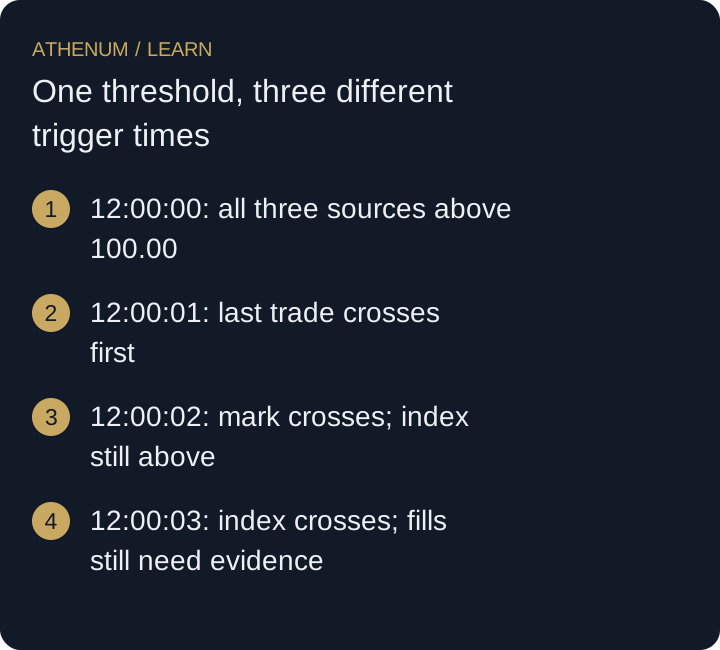 Open full-size diagram
- 12:00:00: all three sources above 100.00
- 12:00:01: last trade crosses first
- 12:00:02: mark crosses; index still above
- 12:00:03: index crosses; fills still need evidence
A candle does not reconstruct event ordering
A screenshot after the fact is insufficient for exact timing. Candle highs and lows compress intrabar events, clocks can differ and an exchange event time is not the time your application received it. Reconstruct source observations and order events on the same timeline. Unknown ordering should remain unknown, not be filled with the sequence that makes the strategy look best.
Before acting
- Record the selected trigger source and direction.
- Align exchange event time with application receipt time.
- Separate triggering, order activation and actual fills.
- Check liquidation on its own source and account assumptions.
- Retain unknown intrabar ordering rather than inventing a favorable sequence.
Check your understanding
At 12:00:02 the last-trade chart is below 100.00 but the index-triggered stop has not activated. Does that alone show an exchange failure?
Show the explained answer
No. The index is still 100.02 at that moment. Its first shown downward crossing is 12:00:03, when it is 99.99. A trigger at that time would still need separate order and fill evidence.