Funding research: reconcile payments, rates and hedge decisions · 2 / 5
Funding interval changes: rebuild the actual settlement ledger
A position opened under an eight-hour funding schedule can remain open after the instrument switches to hourly settlement. Multiplying the entry-time rate by the original number of daily payments misses the actual events. Applying today's schedule to the whole past window can invent events instead. Reconstruct which settlement timestamps belonged to each version of the schedule, then attach the position and rate that applied at each one.
Athenum8 minUpdated:
Version the calendar before calculating money
Record when a schedule was observed, when it became effective, the last settlement under the old schedule and the first under the new one. Those times are different facts. Bybit documents dynamic funding-frequency changes, including a switch to hourly settlement after a rate reaches its preset cap at settlement. Its ticker exposes the next funding time and current interval. One current snapshot cannot, by itself, establish the historical schedule for every earlier hour.
Use archived schedule evidence and dated funding history to construct an ordered calendar. Identify one event by venue, contract and settlement timestamp. A boundary appearing in both old and new records remains one event; do not add the two calendars without resolving their effective ranges. If evidence for a transition is missing, flag the affected period and reconcile it against actual account funding records. Avoid filling the gap with an assumed zero rate.
Attach exposure to each eligible event
For each calendar row, establish whether the position qualified, its settlement notional, the final rate and the signed funding amount. Opening an order does not establish a filled position, and a close submitted near the boundary does not establish that the position was absent. Keep execution evidence and the final account record together. A rate for an hourly event is already that event's rate; do not divide it by eight because the previous event had a longer interval.
Distinguish calculated funding from confirmed posted funding. Public history can establish a settled market rate without proving an individual account payment. An account export can also be incomplete or delayed. Retain a pending-reconciliation state until the required record is available. This makes a missing payment visible instead of making a partially downloaded ledger appear final.
Four eligible events replace the one-event assumption
In this fictional UTC timeline, a short opens at 07:40 and fully closes at 11:20. The old schedule has settlements at 00:00, 08:00 and 16:00. Archived evidence establishes 08:00 as its final event and 09:00 as the first hourly event. Subsequent events are 10:00, 11:00 and so on. This transition is an explicit example assumption, not a claim about a real symbol's historical schedule. The short is confirmed eligible at all four listed events.
Sum the individual signed payments: 50,000 × 0.00016 + 51,000 × 0.00003 − 49,000 × 0.00002 + 50,000 × 0.00004 = 10.55 USDT. Keeping only the old 08:00 event would report 8 USDT and omit a net 2.55 USDT. The 10:00 negative rate is a payment by the short, so treating every row as a receipt would overstate the result. Closing at 11:20 does not prorate the 11:00 event in this settlement-based example.
| Settlement | Schedule version | Notional (USDT) | Settled rate | Short's funding (USDT) |
|---|---|---|---|---|
| 08:00 | Final eight-hour event | 50,000 | +0.016% | +8.00 |
| 09:00 | First hourly event | 51,000 | +0.003% | +1.53 |
| 10:00 | Hourly | 49,000 | −0.002% | −0.98 |
| 11:00 | Hourly | 50,000 | +0.004% | +2.00 |
 Open full-size diagram
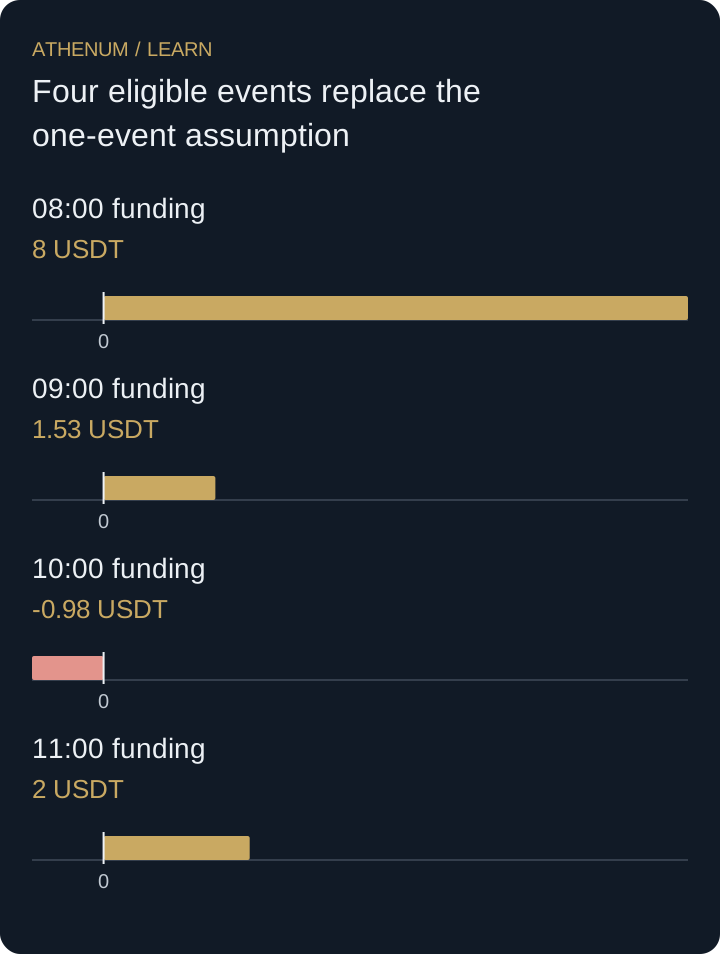
- 08:00 funding: 8 USDT
- 09:00 funding: 1.53 USDT
- 10:00 funding: -0.98 USDT
- 11:00 funding: 2 USDT
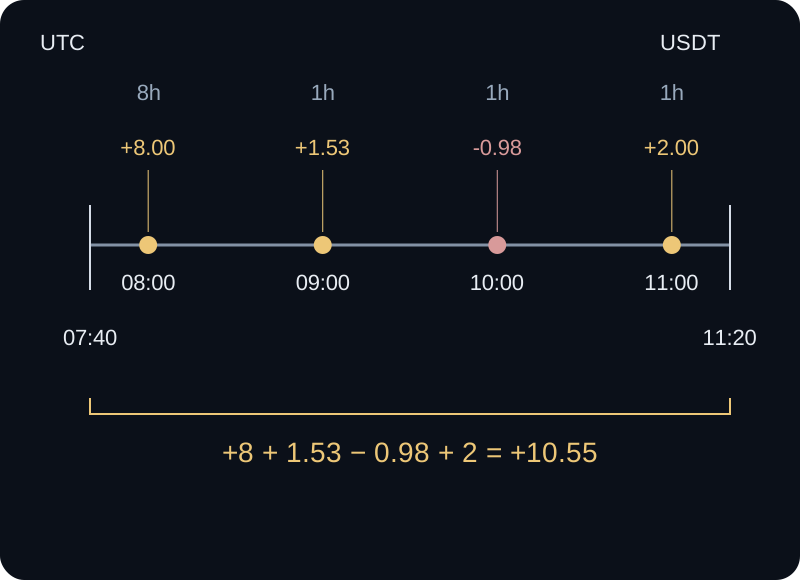
Hypothetical UTC settlement calendar — each listed event appears once.
Horizontal distances follow elapsed time. The 08:00 event is the last eight-hour settlement; 09:00, 10:00 and 11:00 use the new hourly schedule. Positive amounts are receipts by the short, and the negative amount is a payment. Only the four eligible events contribute to the sum.
An interval label is not a complete calendar
Knowing that an instrument now funds every hour does not identify when that regime began or which rate settled at the transition. A backtest that regenerates history from the latest interval can silently change past exposure. Preserve schedule versions and resolve transition boundaries once. Do not extrapolate the fictional 08:00-to-09:00 transition to another instrument without evidence of its actual first new settlement.
Before acting
- Separate schedule observation time from its effective time.
- Identify the final old event and first new event.
- Resolve boundary duplicates before attaching rates.
- Match actual eligible exposure and the settled rate to each timestamp.
- Label missing account payments as pending reconciliation.
Check your understanding
Instead, the example's short fully closes at 10:20, with the earlier positions and rates unchanged. The account export currently contains the 08:00 and 10:00 payments but lacks 09:00. What is calculated funding for the eligible window, what is the posted subtotal, and what remains unresolved?
Show the explained answer
Only 08:00, 09:00 and 10:00 are eligible, so calculated funding is 8 + 1.53 − 0.98 = 8.55 USDT. The available posted subtotal is 8 − 0.98 = 7.02 USDT. The expected 09:00 receipt of 1.53 USDT remains to be reconciled against the account record. It is neither a confirmed zero nor proof that the venue omitted payment. The 11:00 event is outside the confirmed holding window.