Table of Contents6 sections
The decision before the data
The Kelly Criterion sets your optimal bet size from your win rate and payoff. Two worked crypto examples in the free Athenum calculator, plus why professionals bet half Kelly.
| Your question | What to compare | What this cannot establish |
|---|---|---|
| How much can the position lose? | Separate account risk, position notional and posted margin; include fees and exit costs. | Leverage alone does not determine cash PnL when the contract quantity is unchanged. |
| Will a stop protect the account? | Check the trigger price, execution type and the venue's isolated or cross-margin rules. | A stop price is not a guaranteed fill and an isolated model is not a cross-account liquidation calculation. |
| Does the historical result apply now? | Read the sample window, denominator and assumptions before using the result as a stress test. | A historical threshold touch is not a future probability or an observed account liquidation. |
Practise with worked lessons
- Fixed fractional risk: model a losing streak before trading
Compare fixed cash risk with 2% of current equity over five losses. Include size rounding, gaps and fees, and see why smaller size is not protection from ruin.
Reviewed 2026-10-24. We corrected the overbetting example: at even money, assuming a 60% win rate when the true rate is 52% means betting five times the true Kelly fraction (20% versus 4%), not two to three times, and it does turn the system into a loser (about -1.2% expected log-growth per bet). We made the double-Kelly statement exact: in the 60% example growth crosses zero at about 39% of the bankroll and is slightly negative (-0.24% per bet) at 2x Kelly. We clarified that perpetual funding is exchanged at an interval set per contract (8 hours on BTCUSDT at Binance and Bybit, 4 hours on most other Binance contracts and nearly half of Bybit's) and is a cost only on the paying side, specified that the 100x example means a position on the whole account, replaced an unsourced claim about what most trading desks do, and updated the free calculator count to 37. All Kelly fractions, dollar amounts, the 0.5146% growth figure and the fractional-Kelly ratios (74.7% and 43.5% of full-Kelly growth, about 75% and 44% in the continuous approximation) were recomputed and confirmed. Review evidence
TLDR: The Kelly Criterion turns a measured edge into a single number: the fraction of your account to risk on each trade so your capital compounds as fast as possible without going broke. This guide covers the formula, two worked crypto examples in the free Athenum Kelly calculator, why many professionals bet only a fraction of full Kelly, and when Kelly says to bet nothing at all. With Bitcoin near $64,000 on 2026-07-07, the bet size, not the entry, is what decides whether an edge survives a losing streak.
What is the Kelly Criterion and why does bet size decide your returns?
The Kelly Criterion is the mathematically optimal fraction of your bankroll to risk on a bet when you hold an edge. It was derived by John L. Kelly Jr. at Bell Labs in 1956, and Ed Thorp later used it to beat blackjack and run a market-neutral hedge fund for decades. It answers one precise question: given an edge, how much should you stake to grow wealth the fastest without courting ruin?
Bet size matters because returns compound. Two traders can take the exact same setups with the exact same win rate and still finish years apart, purely because one sized the bets well and the other did not. Stake too little and you leave growth on the table. Stake too much and an ordinary losing streak drops your account so far that the edge can no longer dig it out, since a 50% loss needs a 100% gain just to recover. Kelly maximizes the geometric (compounding) growth rate of the account rather than the average trade, and the geometric mean is what actually sets your terminal balance. It is the sizing layer on top of the wider risk-management framework: expected value and your expected-value calculator tell you a trade is worth taking, and Kelly tells you how large to make it.
How do you calculate the Kelly bet size?
For a simple bet with win probability p and net odds b (the profit per $1 risked on a win), the Kelly fraction is:
f = (p(b + 1) - 1) / b, which is the same as f = p - q/b, where q = 1 - p is the chance of losing.
Take a clean example. Say a setup wins 60% of the time at even money (decimal odds 2.0, so b = 1) on a $10,000 account:
- f = (0.60 x 2 - 1) / 1 = 0.20, so full Kelly is 20% of the account, or $2,000. - The edge is +20%, half Kelly is 10% ($1,000), and quarter Kelly is 5% ($500).
The fraction scales with your edge, and it collapses to zero the instant the edge disappears. At even money a 50% win rate is a coin flip with no edge, so Kelly is 0%: do not bet. Below 50% Kelly turns negative, which means the correct size is zero (or you are on the wrong side of the trade).

The Kelly fraction is zero at a 50% win rate and rises with your edge: 60% wins maps to a 20% full-Kelly bet, 75% wins to 50%, at even-money odds of 2.0.
Win rate (even money) | Edge | Full Kelly | Half Kelly |
|---|---|---|---|
50% | 0% | 0% (no bet) | 0% |
55% | +10% | 10% | 5% |
60% | +20% | 20% | 10% |
66% | +32% | 32% | 16% |
75% | +50% | 50% | 25% |
You can run any of these numbers yourself in the free Kelly Criterion calculator, with no account and no sign-up.
What does Kelly look like for a real crypto trade?
Crypto trades are rarely even-money coin flips. You win or lose different amounts depending on where you exit, so the practical inputs are your historical win rate plus your average win and average loss. Kelly then becomes:
f = (W x avgWin - (1 - W) x avgLoss) / avgWin
Worked as a real system: a 45% win rate, an average win of $300, an average loss of $200 (a 1.5-to-1 payoff), on a $10,000 account:
- f = (0.45 x 300 - 0.55 x 200) / 300 = (135 - 110) / 300 = 8.33%, or $833.33 at full Kelly. - Half Kelly is 4.17% ($416.67) and quarter Kelly is 2.08% ($208.33). - The edge is $25 of expected value per trade, and the expected log-growth is 0.5146% per trade.

The free Athenum Kelly calculator on a 45% win rate with a 1.5-to-1 payoff: full Kelly 8.33% ($833.33), edge $25 per trade, expected growth 0.5146% per bet.
Notice that this system loses more often than it wins (45%), and Kelly still says to bet, because the winners are 1.5 times the losers. That is the whole point: edge, not win rate, drives position size. Your risk/reward ratio decides whether that edge exists in the first place, and Kelly decides how hard to press it once it does. Held perpetual positions also exchange funding at an interval set per contract (every 8 hours on BTCUSDT at Binance and Bybit, every 4 hours on most other Binance contracts and on nearly half of Bybit's), so when you are on the paying side, subtract that carrying cost from your average win and add it to your average loss before you trust the edge on longer holds.
Why do professional traders bet half Kelly, not full Kelly?
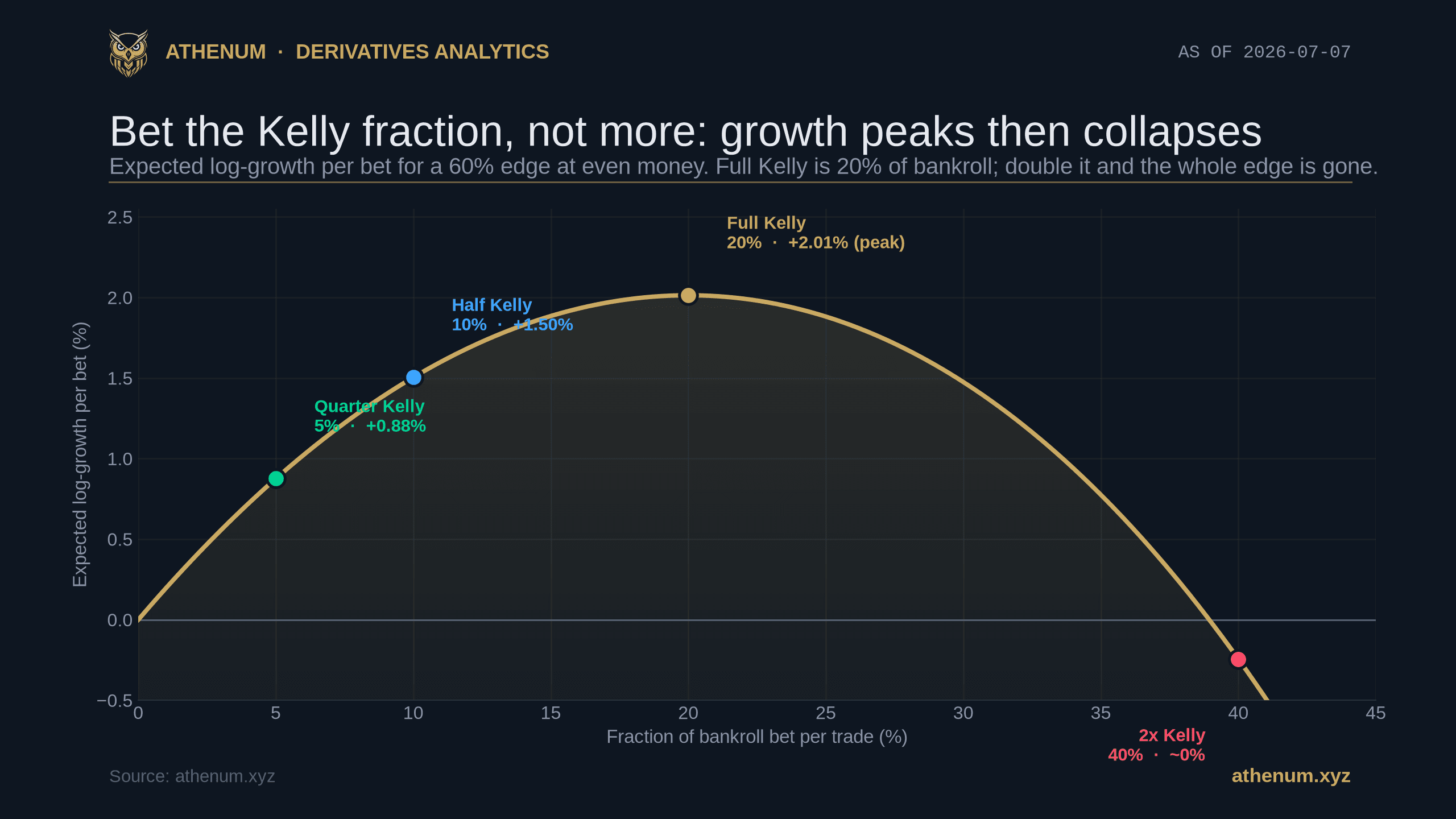
Full Kelly maximizes long-run growth, but it is brutally volatile. Drawdowns of 50% or more are normal at full Kelly even with a genuine edge, because the bet is large relative to the account. The saving grace is that the growth curve is nearly flat at its peak, so you can back a long way off and give up very little growth:
- Half Kelly keeps about 75% of the full-Kelly growth rate at roughly half the volatility.
- Quarter Kelly keeps about 44% of the growth at a quarter of the volatility.
- Overbetting is punished hard and asymmetrically. At about twice the Kelly fraction the expected growth rate is gone: in the 60% example it crosses zero at 39% of the bankroll and is already slightly negative (-0.24% per bet) at 2x Kelly, and beyond that it turns sharply negative. Betting double Kelly is mathematically worse than betting half.

Fractional Kelly for a 60% edge: half Kelly keeps about 75% of the growth at 50% of the volatility, and quarter Kelly keeps about 44% at 25% of the volatility.
That asymmetry is exactly why the growth curve at the top of this post peaks and then rolls over. Leverage makes the trap sharper: a 100x perpetual position on your whole account is an extreme form of overbetting, so size the leverage, not just the entry, and keep your effective bet at or below Kelly rather than above it. Many practitioners treat half Kelly or less as a standing rule, and the fractional-Kelly literature (Thorp, MacLean and Ziemba) explains why: it buys a smoother equity curve for a small, calculable cost in growth.
When does the Kelly Criterion tell you not to bet?
Kelly goes to zero or negative whenever the edge is gone, and it is unforgiving about overconfidence:
- No edge, no bet. A 45% win rate at even money gives f = (0.45 x 2 - 1) / 1 = -10%, and the calculator prints "Don't Bet." A negative Kelly is the model telling you the odds do not pay for the risk.
- Overestimating your edge is the classic path to ruin. If you assume a 60% win rate at even money but the real number is 52%, full Kelly has you betting 20% of the account when the true Kelly is 4%, five times too much, and that overbet quietly turns a winning system into a losing one.
- Kelly assumes independent bets. Crypto positions are often correlated, so five "separate" longs that all fall together are really one big bet, and your true risk is far higher than each per-trade Kelly implies. Crowded positioning is exactly when that correlation bites hardest.
The practical rules follow directly: estimate your edge from a large sample of trades, treat Kelly as a ceiling and never a floor, and when the edge is uncertain, bet a fraction of it and revisit as the sample grows.
The bottom line
A fixed 1% to 2% risk rule and your risk/reward ratio tell you whether a trade is worth taking; the Kelly Criterion tells you how large to make it once the edge is real. Bet the fraction, not the maximum, keep it at half Kelly or less when your edge is uncertain, and treat a negative Kelly as a hard no. Athenum supports 29 exchanges (coverage differs by tool; open interest aggregates 14 exchanges) and gives away 37 free calculators, with no account, no email, and no usage limits. Run your own numbers in the free Kelly Criterion calculator, then start a free 7-day Pro+ trial of the full Athenum terminal, no card required.
One terminal. All the data.
Liquidations, orderbook depth, whale walls & open interest, all real-time, in one place. 29 supported exchanges; coverage differs by tool.
No credit card required

Athenum Analytics
Athenum Analytics is our three-person editorial team covering crypto derivatives, market data and macroeconomic context.