Execution mechanics: from intended orders to actual fills
Work through quantity rounding, maker queues, partial IOC exits, trigger sources and implementation shortfall with original ledgers and reconciled calculations.
What you will practise
Reconcile the intended trade with permitted order parameters, confirmed fills, fees and residual exposure.
Before you start
- Complete the risk and execution course.
- Understand linear position size, limit prices, fees and order-book depth.
Course outline
- 1
Round an executable quantity without increasing the risk budget
Check quantity steps, price ticks and minimum notional against a fixed risk budget. Learn when rounding produces no feasible order.
6 min - 2
Reconstruct a maker queue before assuming a fill
Reconstruct a FIFO queue from an explicit event ledger. Distinguish a trade at your price from your own execution and bound unknown cancellations.
6 min - 3
Reconcile an IOC partial fill and the exposure it leaves behind
Calculate an IOC exit's average fill, fees and remaining exposure. A cancelled remainder does not mean the original position is closed.
6 min - 4
Align a stop trigger with the price series that actually activates it
Compare last-trade, mark and index triggers on one timeline. Separate activation from execution and identify the limits of candle-based evidence.
6 min - 5
Measure implementation shortfall against a declared decision benchmark
Account for executed-price differences, fees and unfilled opportunity cost. Reconcile decision and arrival benchmarks without double-counting delay.
6 min
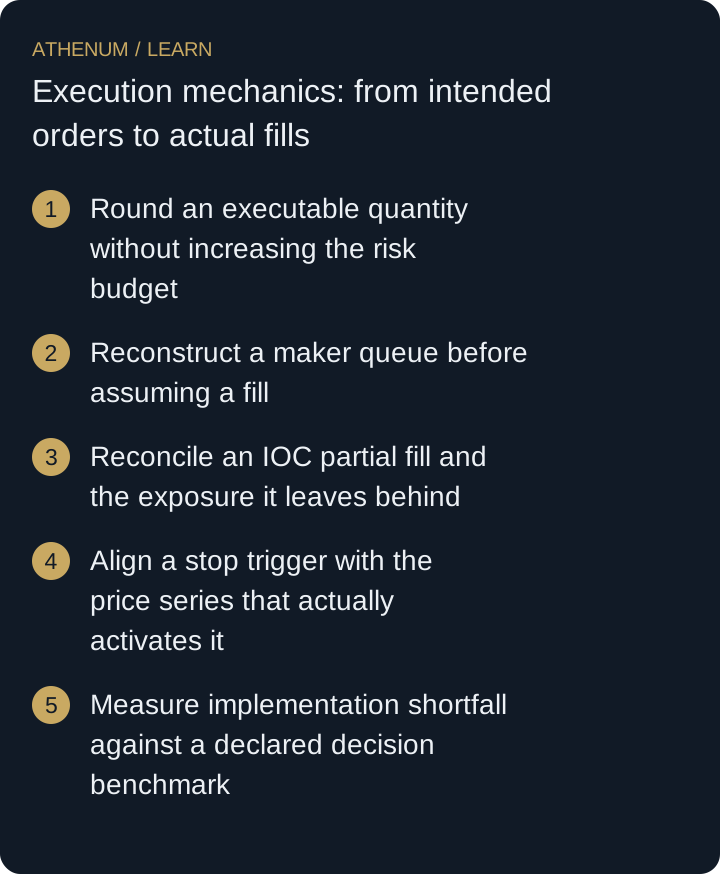 Open full-size diagram
- Round an executable quantity without increasing the risk budget
- Reconstruct a maker queue before assuming a fill
- Reconcile an IOC partial fill and the exposure it leaves behind
- Align a stop trigger with the price series that actually activates it
- Measure implementation shortfall against a declared decision benchmark
Educational material. Examples do not establish a profitable strategy. Trading costs, gaps and liquidation can produce losses beyond a planned stop.