Orderflow measurement: resets, units and information timing · 3 / 5
Base versus quote volume delta: why the signs can disagree
Base delta counts signed asset units. Quote delta weights every signed execution by its own price. When buy and sell executions occur at different prices, the two totals can even have opposite signs without any data contradiction.
Athenum7 minUpdated:
Write both sums before converting anything
For trade i, let s_i be +1 for a buyer aggressor and −1 for a seller aggressor, q_i the base quantity and p_i the execution price in quote units per base unit. Base delta is Σs_iq_i. Quote delta is Σs_iq_ip_i. Convert each trade at its own price before summing.
Multiplying total base delta by the final price generally does not reproduce quote delta. It substitutes one valuation price for the different execution prices. A dollar display may also require a separate conversion when the quote asset is not USD. Stablecoin quotations are not automatically identical dollar measurements in all conditions.
Do not sum incomparable contracts
Confirm whether quantity means coins, linear contract units or inverse USD contracts. A multiplier or reciprocal payoff may be needed before comparing products. Units are part of the observation, not a formatting preference that can be fixed after unrelated totals are added.
For a multi-venue total, normalize each compatible execution and document excluded venues. A change from base to quote delta changes price weighting; adding or removing a venue changes coverage. Treat these as separate effects when interpreting an apparent shift in flow.
Worked example: more base bought, more quote value sold
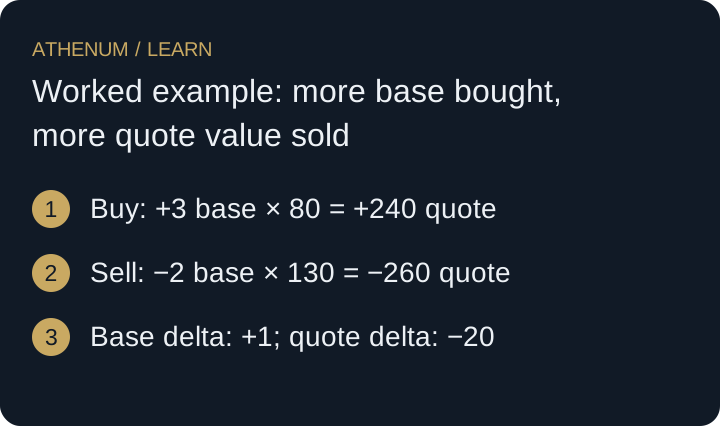
Use a deliberately wide-price hypothetical interval to make the weighting visible. Buyer aggressors purchase 3 base units at 80, worth 240 quote units. Seller aggressors sell 2 base units at 130, worth 260. Base delta is +1; quote delta is −20.
Multiplying +1 by the final price of 130 gives +130, which is neither the observed −20 quote delta nor a reconciliation of the tape. Total unsigned base volume is 5 and total traded quote value is 500. These quantities describe activity, not cash deposited into the market or net wealth creation.
| Taker side | Base quantity | Execution price | Signed base | Signed quote |
|---|---|---|---|---|
| Buy | 3 | 80 | +3 | +240 |
| Sell | 2 | 130 | −2 | −260 |
| Net | — | — | +1 | −20 |
 Open full-size diagram
- Buy: +3 base × 80 = +240 quote
- Sell: −2 base × 130 = −260 quote
- Base delta: +1; quote delta: −20
Notional flow is not net capital inflow
Every trade exchanges assets between counterparties. A positive buyer-aggressor notional sum does not measure money entering an exchange, a fund subscription or an increase in outstanding contracts. Use deposits, holdings or open-interest data for those different questions and respect their separate reporting conventions.
Before acting
- Verify base, quote and contract multipliers.
- Multiply each execution by its own price.
- Keep signed delta distinct from unsigned volume.
- Explain price weighting before treating a sign disagreement as an error.
Check your understanding
Buyer aggressors trade 4 units at 25; seller aggressors trade 3 units at 40. Calculate base delta, quote delta and total unsigned quote volume.
Show the explained answer
Base delta is 4 − 3 = +1 unit. Quote delta is 4 × 25 − 3 × 40 = −20 quote units. Total unsigned quote volume is 100 + 120 = 220. Multiplying the +1 base delta by the last price of 40 would give the wrong quote delta.