Funding, crowding and basis · 2 / 5
Compare hourly and eight-hour funding on equal terms
A smaller funding rate can cost more if it settles more often. Always read the interval next to the percentage. Annualisation is a comparison convention, not evidence that the rate will persist or that an account can earn that return.
Athenum8 minUpdated:
Translate the rate and interval together
If r is a per-settlement rate and h the interval in hours, a simple constant-rate daily projection is r × 24 ÷ h. A simple annual projection is r × 24 ÷ h × 365. These formulas hold the rate, interval and notional constant. They do not describe a real sequence of changing settlements.
Use the same sign convention and distinguish a projected next rate from settled history. When an exchange changes an instrument's interval, do not continue multiplying by the old number of settlements. For historical analysis, sum the actual dated payments or normalise each observation with its contemporaneous interval.
APR is not return on your collateral
A notional-based annualised rate uses exposure as its denominator. Return on account equity depends on collateral, hedge costs, fees, price movement and margin constraints. Multiplying a funding APR by leverage can describe one isolated arithmetic component while omitting the risks that determine whether the position survives.
Compounded projections assume that proceeds can be reinvested at the same rate and that losses, costs and capacity do not interfere. Those assumptions are especially strong for a rate that can change or flip sign. Keep simple annualisation labelled as a snapshot comparison and use actual cash flows for realised performance.
0.005% hourly costs twice as much as 0.02% every eight hours
Venue A shows +0.005% every hour. Under a constant-rate assumption, that is 0.12% per day and 43.8% simple annualised. Venue B shows +0.02% every eight hours: 0.06% per day and 21.9% simple annualised. Venue C shows +0.01% every four hours and has the same simple daily projection as B.
On an unchanged 10,000 USDT long notional, the projected daily payment is 12 USDT at A and 6 at B or C. This is a comparison exercise, not a forecast or a recommendation to move venues. Execution, basis, collateral rules and rate changes can outweigh the displayed funding difference.
| Venue | Rate / interval | Daily projection | Simple APR |
|---|---|---|---|
| A | 0.005% / 1h | 0.12% | 43.8% |
| B | 0.02% / 8h | 0.06% | 21.9% |
| C | 0.01% / 4h | 0.06% | 21.9% |
- A: hourly
- 12 USDT / day
- B: eight-hour
- 6 USDT / day
- C: four-hour
- 6 USDT / day
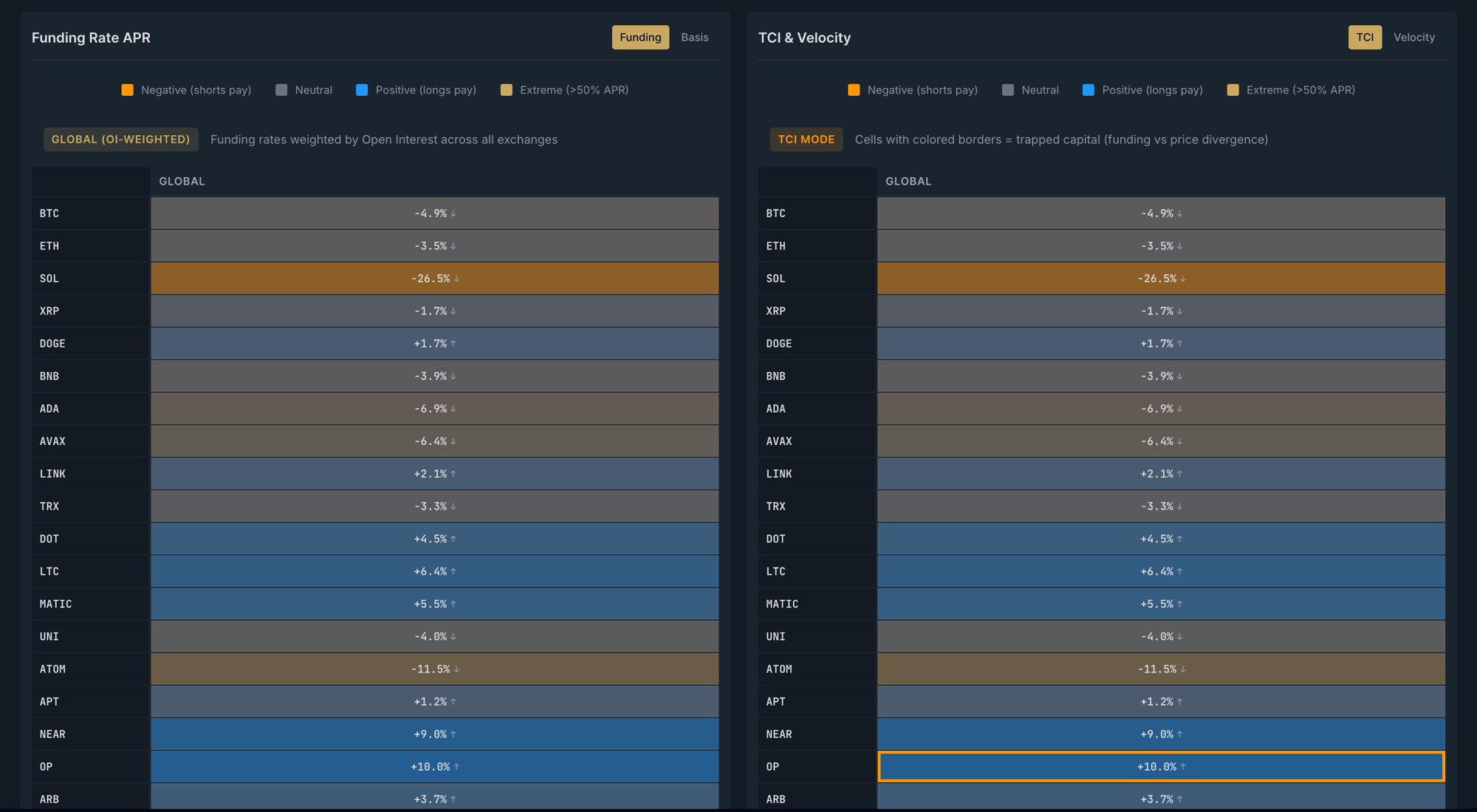
An aggregate average can hide the contract you hold
An OI-weighted funding summary combines venues or instruments according to its weights. Your actual payment comes from your own contract and settlement notional. A benign aggregate can coexist with an expensive specific position. Use the aggregate for context and the instrument-level ledger for cash-flow planning.
Before acting
- Read rate, interval, timestamp and estimate-versus-settled status together.
- Convert all comparisons to the same horizon and sign convention.
- Label simple APR separately from compounded projections.
- Do not confuse notional-based rates with account returns.
- Check the specific contract behind any aggregate heatmap.
Check your understanding
A contract changes from 0.01% every eight hours to 0.004% every hour. Under constant-rate assumptions, does daily funding become cheaper?
Show the explained answer
No. The old daily projection is 0.01% × 3 = 0.03%. The new one is 0.004% × 24 = 0.096%, or 3.2 times as much. The lower headline percentage hides the greater settlement frequency.