Funding rates and basis trades: costs, crowding and carry · 3 / 5
Distinguish crowded positioning from a squeeze
Crowding describes a potentially vulnerable positioning environment. A squeeze describes a process in which adverse price movement pressures positions to close. The first can exist for a long time without the second occurring.
Athenum8 minUpdated:
What funding and open interest say about crowding
Positive funding usually transfers value from longs to shorts, while negative funding reverses the transfer. The rate is related to the perpetual's pricing mechanism, not a direct census of bullish and bearish people. Every outstanding contract still has both sides, and some positions hedge other exposures.
Call a rate unusual only relative to an appropriate history and interval. Compare the same instrument and distinguish temporary estimates from settled observations. Rising normalised OI can indicate growing exposure, but it does not reveal leverage distribution or the number of accounts close to liquidation. A high rate and high OI together provide context, not a timed entry.
Short vs long squeeze: adverse price move and forced exits
For a short-squeeze hypothesis, price moves upward against shorts and position reductions may add buying pressure. For a long squeeze, the adverse direction is downward and reductions may add selling pressure. Reported liquidation events provide evidence of covered forced exits; voluntary covering and broader spot demand may coexist.
Use price response to separate a vulnerability from its activation. Negative funding during a continuing decline does not require price to rise. Positive funding during an orderly advance does not require a collapse. A contrary trade needs a defined trigger, invalidation and execution budget, just like any other setup.
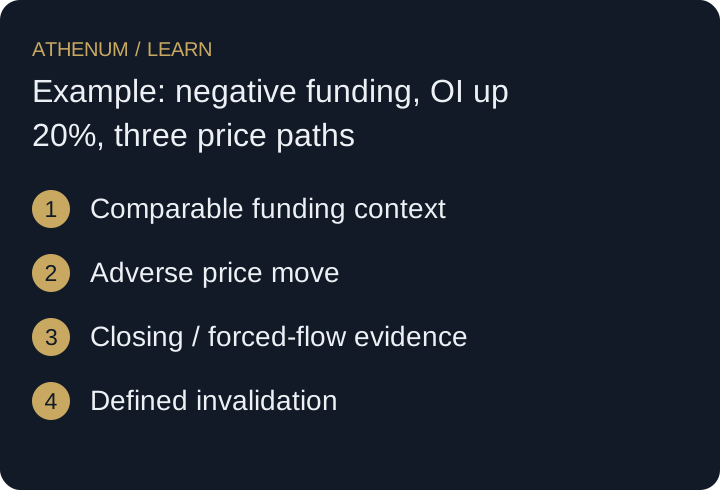
Example: negative funding, OI up 20%, three price paths
Imagine an instrument with unusually negative funding relative to its own settled history and OI 20% above the start of the selected window. Path A keeps falling while OI grows: the short-squeeze hypothesis has not activated. Path B rises through a predefined boundary while OI contracts and covered short liquidations increase: a squeeze explanation gains support.
Path C rises while OI grows and no forced-close evidence is observed in the covered feed. That can involve new exposure and wider demand, but the absence of reports is not proof that no shorts closed anywhere. In all cases, the exact positions and motives remain partly unknown. The trade rule should depend on observable conditions, not a claim that the market owes one side a punishment.
| Path | Price | Normalised OI | Interpretation to test |
|---|---|---|---|
| A | Continues down | Rises | No observed upside activation |
| B | Breaks upward | Falls | Closures; reported short liquidations support squeeze |
| C | Rises | Rises | New exposure; cause remains ambiguous |
 Open full-size diagram
- Comparable funding context
- Adverse price move
- Closing / forced-flow evidence
- Defined invalidation
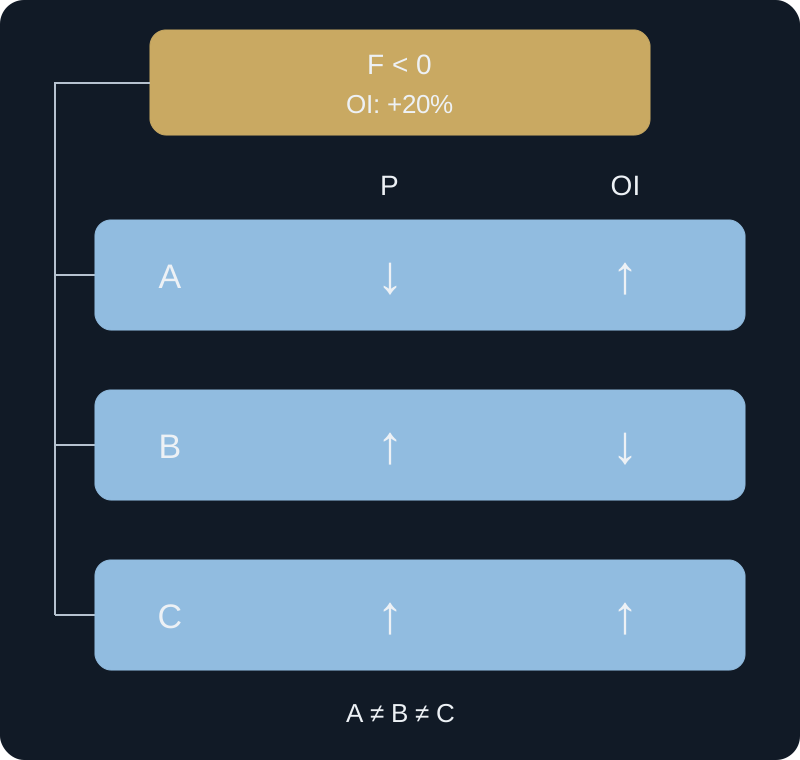
One crowding context, several different observations. Crowding becomes a squeeze hypothesis through observed price and closing pressure, not through the funding sign alone.
F is the settled funding rate, P price and OI normalised open interest. +20% describes the shared initial context, not any later path. A, B and C are alternatives, not consecutive stages or equally likely outcomes. Arrows show direction only. B additionally needs the predefined boundary break and covered short-liquidation evidence described below; its arrows alone do not prove a squeeze. C has no observed forced-close reports in the covered feed, not proven absence of closures everywhere.
Mistake: shorting high positive funding without a price trigger
Shorting solely because positive funding looks high can accumulate both adverse price P&L and execution costs even while collecting funding. Receiving a payment does not neutralise directional exposure. If the intended contrarian trigger never occurs, continuing to hold for the narrative changes the strategy and its risk profile.
Before acting
- Normalise funding intervals and OI units before labelling an extreme.
- Separate a vulnerable context from an activated price condition.
- Check the side and coverage of reported liquidation events.
- Allow hedging and new exposure as alternative explanations.
- Evaluate full P&L, not funding receipts alone.
Check your understanding
Funding is strongly positive, but price keeps rising and no bearish trigger occurs. Is opening a short justified by the funding observation alone?
Show the explained answer
No. Positive funding establishes the payment direction under the contract's rules, not the timing of a reversal. A short needs its own tested entry and invalidation conditions. Funding received can be far smaller than the loss from an adverse price move.
Sources and further reading
Continue with Athenum
From the Athenum blog
The Long/Short Ratio and Open Interest: Reading Crowd Positioning in Crypto Futures
Related lessons
- Test a trapped-trader hypothesis without inventing positions
Frame a trapped-trader hypothesis with a fixed range, normalised open interest and price response. Separate supporting evidence from proof of entries or stops.
- Long/short ratio: compare account counts with position size
Calculate long-holder share, the account ratio and open interest from one ledger. More long accounts do not prove greater long exposure in the market.