Audit open-interest data before interpreting it · 1 / 5
Long/short ratio: compare account counts with position size
A market can have many more long holders than short holders while its matched contract quantities remain equal. Before interpreting a ratio, reconstruct its denominator and what it does not measure.
Athenum8 minUpdated:
Task
Reconcile a count-based sentiment measure with matched contract quantities. Before interpreting a ratio, name its population, weighting and treatment of hedged accounts. The following deliberately simple market has ten distinct accounts, one instrument and no account holding both sides. Every position has the same contract specification; this is a complete fictional population, not a claim about the exchange's internal classification of complex accounts.
Change the population, not the exposure
Now replace each of the two four-contract short accounts with four separate one-contract short accounts, leaving the eight long accounts unchanged. This is an alternative ownership ledger, not an instruction to split accounts and not an assumed observable transfer mechanism. The quantity on each side is still eight. There are now sixteen holders: eight long and eight short. The long proportion falls from 80% to 50%; the account ratio falls from four to one. OI need not change at all between those two possible states.
Conversely, doubling every account's quantity in the original ledger raises one-sided OI from eight to sixteen while preserving the 80% long-account share. A stable count ratio is therefore not proof of stable exposure.
Worked ledger
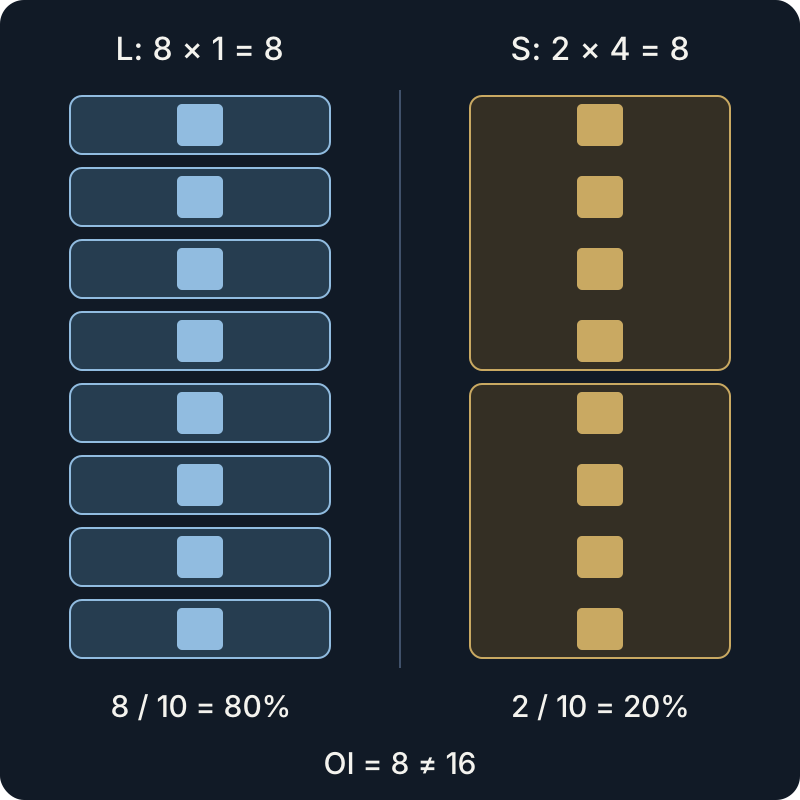
Eight of ten position holders are long: 80%. Two of ten are short: 20%. The long-to-short account-count ratio is 8/2 = 4. Yet the long and short contract totals both equal eight. Under a one-sided outstanding-contract convention, OI is eight, not sixteen. The sixteen side-counted positions are not sixteen different matched contracts.
The apparent conflict disappears once the denominator is explicit. A count gives a one-contract account and a four-contract account equal weight. A quantity-weighted measure does not. The eight long accounts may have different collateral, entry prices and hedges elsewhere; none of those facts appears in this ledger. Calling them weaker, more leveraged or likely to be liquidated would add information the example does not contain.
| Account group | Accounts | Contracts per account | Total contracts |
|---|---|---|---|
| Long-only | 8 | 1 | 8 long |
| Short-only | 2 | 4 | 8 short |
 Open full-size diagram
- 8 long holders and 2 short holders
- 8 long contracts and 8 short contracts
- 80% long holders; 8 outstanding matched contracts
Failure case
An analyst reads 80% long holders and multiplies 8 OI by 0.8 to announce 6.4 long contracts versus 1.6 short contracts. This does not reconstruct the ledger and does not conserve matched contract sides. The ratio describes holders, not a partition of outstanding contracts into unpaired bets.
Do not repair this by silently changing to a top-trader ratio. A selected cohort is a different population; its counterparties may lie outside it. Account counts, cohort notional ratios and full-market OI need separate labels.
Before acting
- Name the counted population and denominator.
- Separate holder counts from position quantities.
- Declare one-sided or both-sided OI reporting.
- Do not infer collateral, leverage or external hedges from account counts.
Check your understanding
In a separate complete toy market, six long-only holders each own two contracts. Three short-only holders each own four contracts. Compute the long-holder proportion, count ratio and one-sided OI. Can you infer net bullish dollar exposure across all other markets?
Show the explained answer
6/9 = 66.666…%, 6/3 = 2, and 12 outstanding contracts. Both sides sum to twelve. No cross-market exposure inference is possible: prices, contract value and external hedges are unspecified. Rounding the percentage does not change the exact count calculation.