Audit open-interest data before interpreting it
Five original data audits covering account counts, venue coverage, record availability, volume consistency and weighted holder ratios.
What you will practise
Reconcile what an OI dataset can establish, identify incompatible observations and keep missing information out of trading narratives.
Before you start
- Reconstruct opening, closing and transfer events in a one-sided contract ledger.
- Distinguish contract quantity from dollar notional and measurement time from decision time.
Course outline
- 1
Long/short ratio: compare account counts with position size
Calculate long-holder share, the account ratio and open interest from one ledger. Explain why more long accounts do not prove greater long exposure.
8 min - 2
Open interest data gaps: compare a consistent venue panel
Separate changing open interest from missing, stale or restored venue data. Reconcile visible totals against the same exchange panel at each timestamp.
8 min - 3
Open interest backtests: handle delayed data and revisions
Replay OI using the values actually available at decision time. Track delayed reports and corrections without allowing future information into the test.
8 min - 4
Open interest vs volume: check each interval for consistency
Compare OI changes with traded volume in matching contract units. Find interval-level discrepancies that disappear when only whole-window totals are checked.
8 min - 5
Aggregate long/short ratios: weight account counts correctly
Pool compatible long and short account counts across venues. Explain how the combined long share can rise while every venue's share falls.
8 min
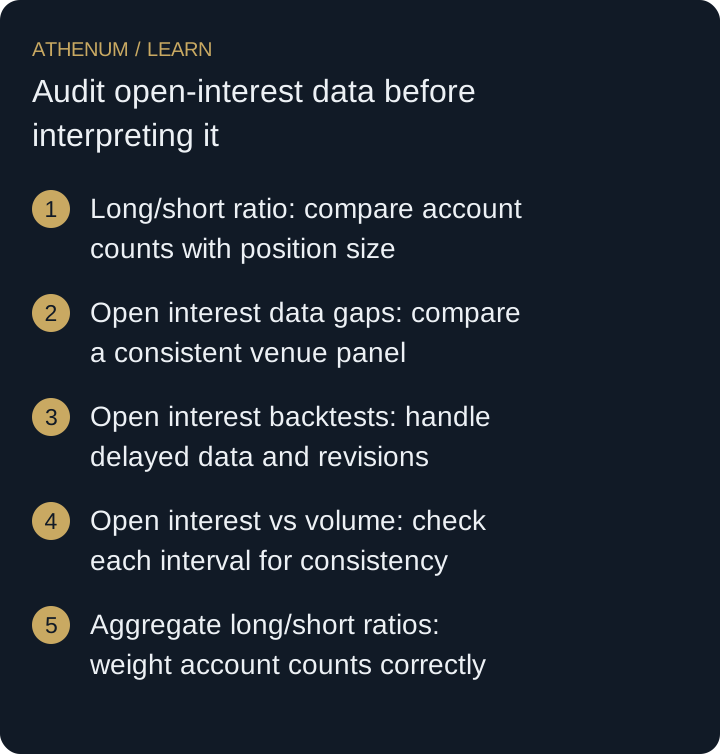 Open full-size diagram
- Long/short ratio: compare account counts with position size
- Open interest data gaps: compare a consistent venue panel
- Open interest backtests: handle delayed data and revisions
- Open interest vs volume: check each interval for consistency
- Aggregate long/short ratios: weight account counts correctly
Educational material. Examples do not establish a profitable strategy. Trading costs, gaps and liquidation can produce losses beyond a planned stop.