Portfolio risk: drawdown, sizing and daily limits · 5 / 5
Daily loss limit: reserve open risk before taking another trade
A daily loss limit is incomplete if it ignores positions that are still open. Before another entry, reconcile the realized loss already spent, the modeled loss still committed and the reserve for execution. A threshold controls decisions; it cannot guarantee the eventual fill price.
Athenum7 minUpdated:
Choose one loss accounting policy
A policy can use net daily P&L, gross losing trades, marked equity decline or a trailing intraday peak. These are different rules. The worked example uses a fixed loss allowance from start-of-day equity, net realized losses already booked and remaining loss measured from current marks. Open P&L must be handled consistently so it is not omitted or counted twice.
Define the day boundary and timezone, especially in 24-hour markets. A clock reset does not flatten positions or erase their risk. Also decide whether realized profits increase the allowance. A conservative fixed-loss policy may decline to recycle profits; a net-P&L policy may permit it. Neither convention should change opportunistically after a losing trade.
Reserve what can still be lost
The admission calculation in this lesson is remaining budget = daily allowance − realized loss spent − modeled additional open loss − extra execution reserve. The open loss is incremental from the marks already included in the accounting baseline. If the baseline is marked equity instead of realized P&L, reconcile unrealized losses explicitly before using the same expression.
Specify what reaching the threshold does: reject new entries, cancel unfilled entry orders, or initiate reductions according to the plan. Cancelling an entry order does not close a position. A local alert is also not the same as an exchange-enforced control; loss can continue during latency, gaps or service outages.
Worked example: cash remaining is smaller than the headline limit
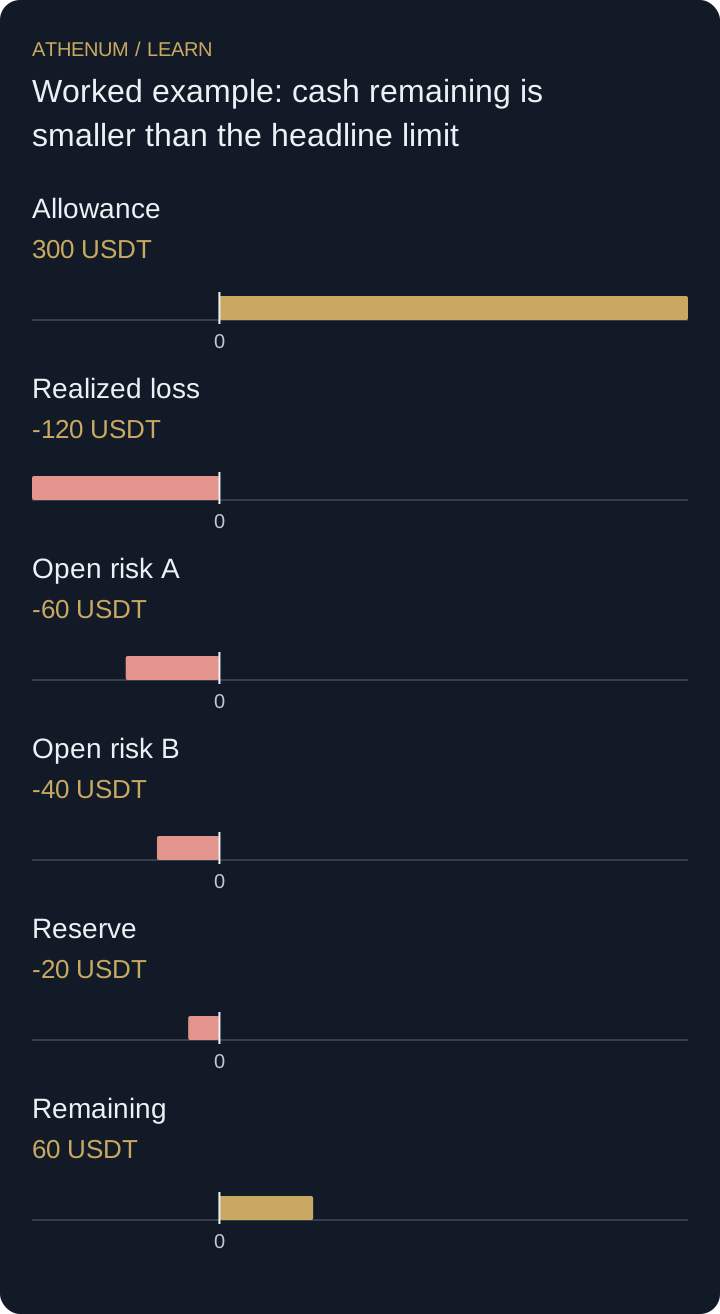
A hypothetical account starts at 10,000 USDT with a 300-USDT daily allowance. It has booked 120 of net realized losses, and two positions have no current unrealized P&L but modeled additional losses of 60 and 40. A separate 20-USDT execution reserve is not included in those position estimates. Remaining admission capacity is 300 − 120 − 60 − 40 − 20 = 60.
A new trade requesting 90 USDT of total modeled loss exceeds the remaining budget by 30. Cutting the quantity to fit must use actual contract increments and preserve its strategy invalidation; moving the stop arbitrarily closer merely to make the arithmetic fit changes the trade. If no valid order fits, the rule rejects it.
| Budget item | USDT |
|---|---|
| Daily allowance | 300 |
| Realized loss spent | −120 |
| Open risk A | −60 |
| Open risk B | −40 |
| Additional reserve | −20 |
| Remaining admission capacity | 60 |
 Open full-size diagram
- Allowance: 300 USDT
- Realized loss: -120 USDT
- Open risk A: -60 USDT
- Open risk B: -40 USDT
- Reserve: -20 USDT
- Remaining: 60 USDT
A new calendar day does not create risk-free capacity
If yesterday’s positions remain open after the reset, they still need a place in today’s risk accounting. Ignoring them while assigning the full fresh allowance to new trades compounds exposure. Likewise, a threshold-triggered market exit may fill after the loss has passed the threshold. Record both the trigger breach and final executed loss.
Before acting
- Define the day, timezone and whether profits replenish capacity.
- Reconcile realized and unrealized P&L under one baseline.
- Reserve additional open-position loss and avoid double-counting costs.
- Specify threshold actions and verify actual cancellation or fill states.
Check your understanding
The daily allowance is 250 USDT. Realized losses are 80, additional open risk is 95 and the separate reserve is 15. What remains? What changes if an existing stop then loses 25 more than modeled?
Show the explained answer
Capacity is 250 − 80 − 95 − 15 = 60 USDT. If the 25-USDT overrun is incremental to the modeled amounts and not already absorbed by the reserve, capacity falls to 35. Reconcile the closed position out of open risk and its realized loss into the ledger; do not subtract its full loss twice.