Portfolio risk: drawdown, sizing and daily limits
Reconcile drawdown recovery, losing streaks, correlated exposure, lagged volatility sizing and daily risk budgets with original worked examples.
What you will practise
Calculate what a new trade adds to account risk and identify where stop plans, historical estimates and accounting conventions can fail.
Before you start
- Calculate linear trade P&L and distinguish notional from loss allowance.
- Understand current equity, stop execution and position-size rounding.
Course outline
- 1
Drawdown recovery: calculate the return needed to break even
A 25% drawdown needs a 33.33% gain to recover. Calculate peak-to-trough loss and the recovery on remaining equity, and keep deposits out of the result.
7 minIn short: With peak equity H and current equity E, drawdown d = (H − E) / H, and the return needed to regain the peak is H / E − 1 = d / (1 − d). A 25% drawdown needs 33.33%, a 50% drawdown 100%. Keep deposits and withdrawals out of the result.
- 2
Fixed fractional risk: model a losing streak before trading
Compare fixed cash risk with 2% of current equity over five losses. Include size rounding, gaps and fees, and see why smaller size is not protection from ruin.
7 minIn short: Fixed fractional risk removes fraction f of current equity per loss, so after n losses E_n = E_0 × (1 − f)^n and each planned cash loss shrinks; fixed cash risk does not. Five 2% losses cost about 9.608%, not 10%. Gaps, fees and liquidation can make real losses differ from the plan.
- 3
Portfolio heat: add correlated positions before sizing a new trade
Add planned stop losses across BTC, ETH and altcoin positions before a new trade, then stress a joint shock. Correlated trades do not have separate budgets.
7 minIn short: Portfolio heat = sum of every position’s modeled loss to its exit, including fee and slippage allowances, ÷ current equity; correlated trades do not get separate budgets. Stress a joint shock separately: in the example, a 200 USDT stop plan (2% heat) loses 380 USDT in the shock scenario.
- 4
Volatility position sizing: stress the lag in an ATR-based rule
The same risk budget admits twice the size after a calm window. Calculate an ATR-based quantity, then stress a volatility jump before the estimate updates.
7 minIn short: For a linear contract, quantity in base units = cash risk allowance ÷ stop distance per unit, so a k × ATR stop makes size vary inversely with ATR. When ATR halves after a calm window, the same budget admits twice the quantity, and a 12-unit adverse move then costs 240 instead of 120 USDT gross.
- 5
Daily loss limit: reserve open risk before taking another trade
A daily loss limit must count positions still open. Reconcile realized losses, open risk and cost reserves before the next trade, and define the reset time.
7 minIn short: Remaining allowance = daily limit − marked daily loss − additional modeled loss from current marks − execution reserve. In the example, a 300 USDT limit with 120 of realized loss, open risks of 60 and 40 and a 20 reserve leaves 60 USDT. A day reset does not erase the risk of positions still open.
Calculators used in this course
Related courses
- Position sizing and leverage: risk, stops and feesSize a position from invalidation, distinguish leverage from exposure and test whether a setup survives real trading costs.
- Backtest statistics: test what a trading result really saysInterpret compounding, profit factor, overlapping trades, net benchmarks and bootstrap assumptions with independently calculated examples.
- Crypto margin and collateral: reconcile account exposureWork through inverse P&L, shared-equity stress, conditional collateral deposits, maintenance deductions and marginal collateral bands.
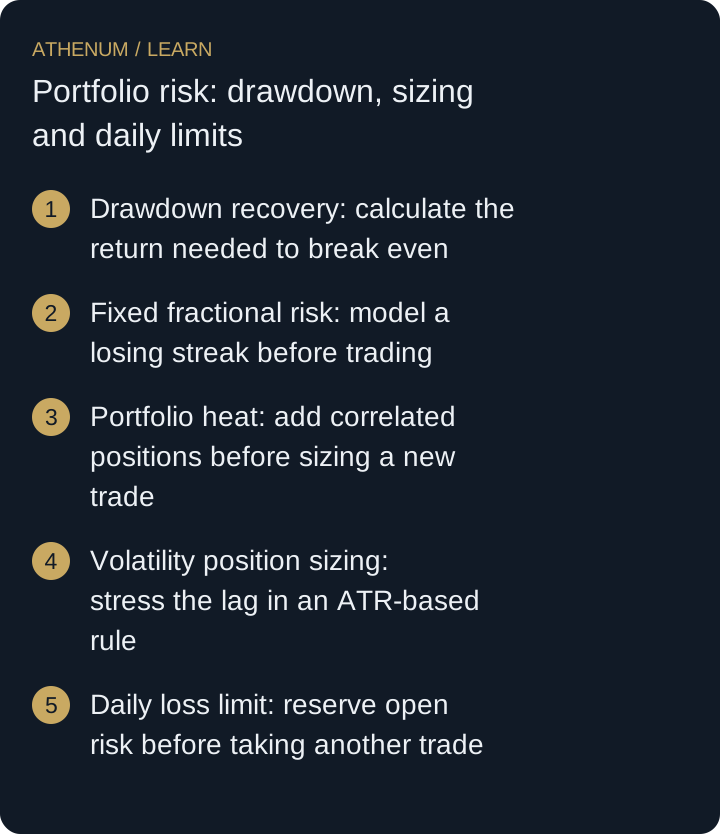 Open full-size diagram
- Drawdown recovery: calculate the return needed to break even
- Fixed fractional risk: model a losing streak before trading
- Portfolio heat: add correlated positions before sizing a new trade
- Volatility position sizing: stress the lag in an ATR-based rule
- Daily loss limit: reserve open risk before taking another trade
Educational material. Examples do not establish a profitable strategy. Trading costs, gaps and liquidation can produce losses beyond a planned stop.