Portfolio risk: drawdown, sizing and daily limits · 3 / 5
Portfolio heat: add correlated positions before sizing a new trade
Three positions can share one market driver. Portfolio heat adds their planned losses under a stated stop scenario; a joint stress test asks what happens if correlated moves and worse fills occur together. Use both before admitting a new position.
Athenum7 minUpdated:
Portfolio heat formula and the limits of correlation
For each position, calculate the loss from its current decision reference to its modeled exit, including fees and slippage allowances. Express all losses in one account currency. Their sum divided by current equity is the declared portfolio heat. If you instead measure risk from each original entry, label that convention and do not mix it with current-equity risk.
Historical correlation describes a sample of returns, at a specified interval and over a specified window. It does not say that future stop events are independent or that a low historical correlation prevents a common shock. Two positively correlated long positions may lose together; a long and short can still have basis, size and venue mismatches.
Joint-shock stress test for correlated positions
A joint-shock scenario supplies a possible price move and executable loss for every position. It is not a probability forecast or a value-at-risk estimate. Include collateral revaluation and other liabilities only in the relevant account model; avoid counting the same collateral loss twice.
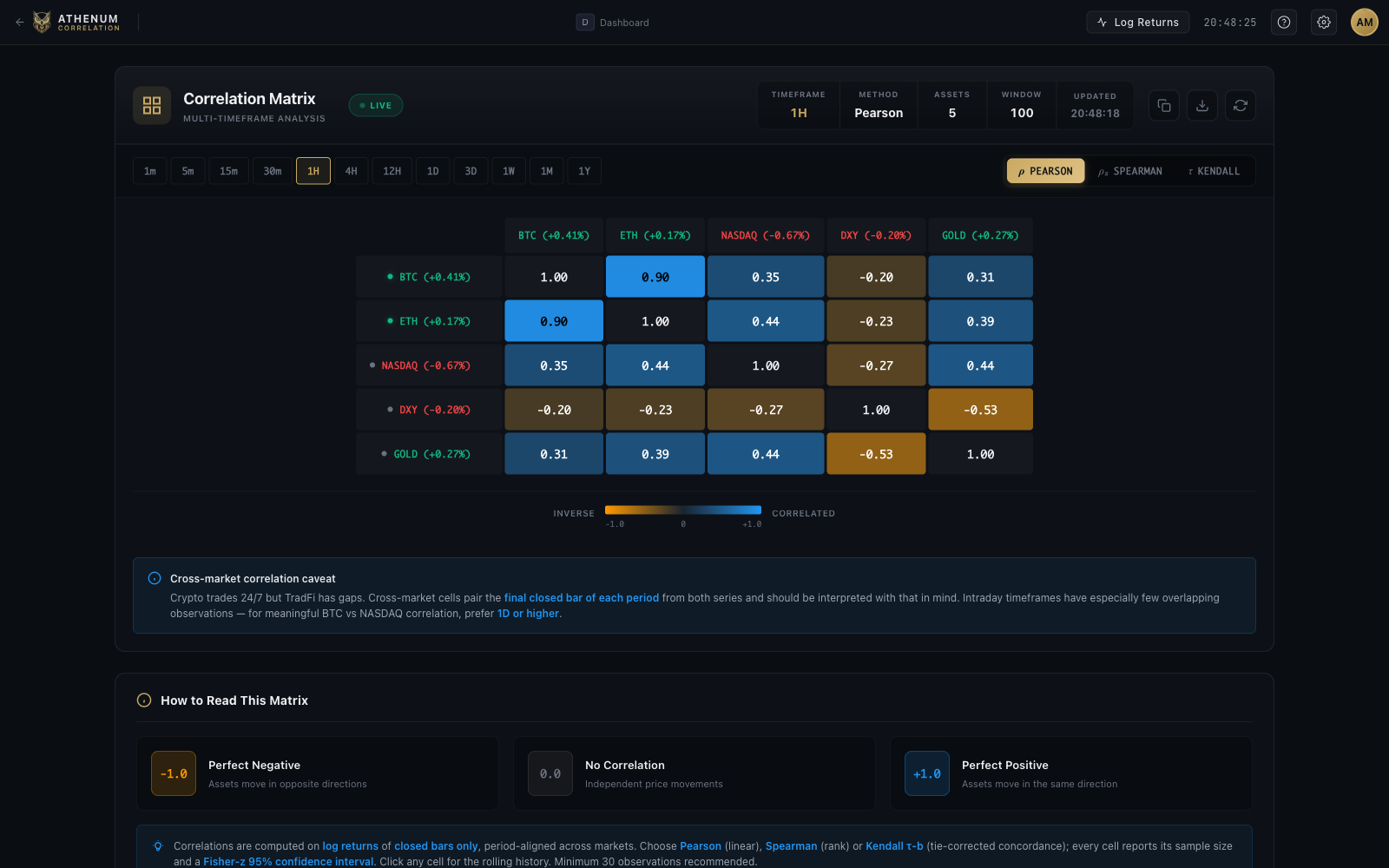
An Athenum correlation view can help identify relationships to investigate, but the matrix is not an admission rule. Record symbols, venues, return interval, window and missing data. Then construct at least one scenario in which historical diversification is weaker and stops fill beyond their intended prices.
Example: a fourth trade lifts heat to 2.8% over a 2.5% cap
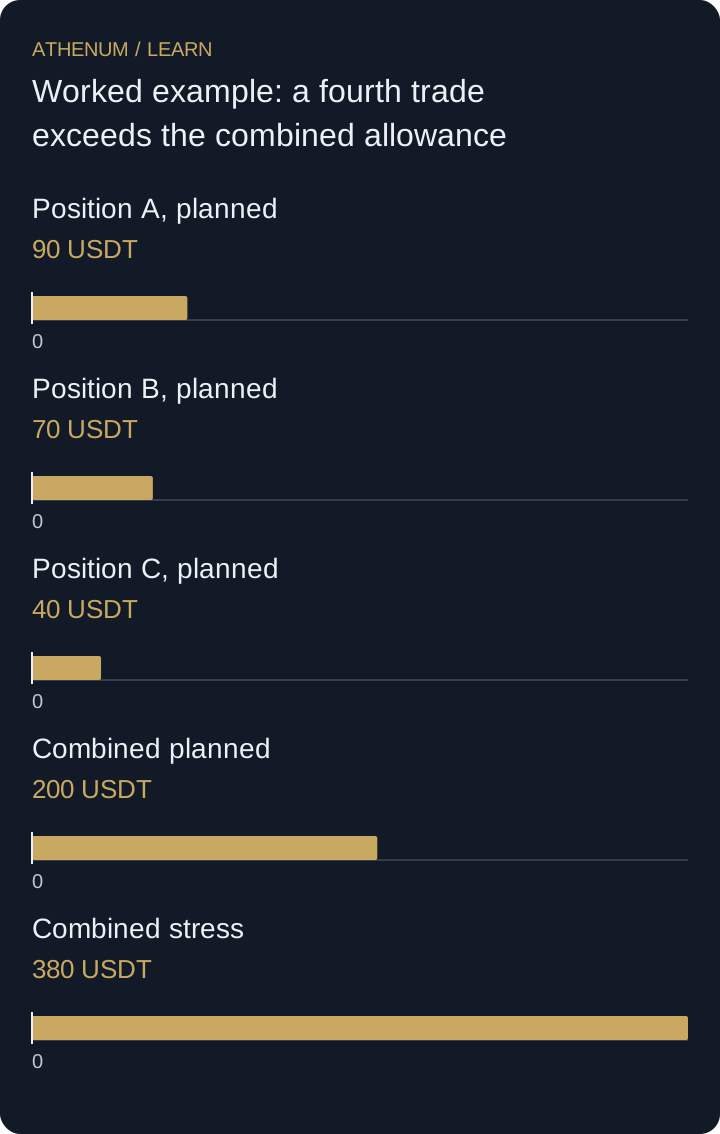
A hypothetical 10,000-USDT account holds three linear long positions. Their modeled losses from current marks, including cost allowances, are 90, 70 and 40 USDT: 200 in total, or 2% heat. A proposed fourth trade adds 80, bringing heat to 2.8%. If the predeclared combined cap is 2.5%, only 50 USDT of additional modeled loss fits.
A separate common-shock scenario produces losses of 150, 130 and 100 on the existing positions, totaling 380 or 3.8% of equity. This does not change the arithmetic of the 200-USDT stop plan; it reveals that the plan is not a guaranteed maximum. Reducing the fourth trade to a 50-USDT modeled loss still requires checking its own shock exposure.
| Position | Planned loss (USDT) | Joint-shock loss (USDT) |
|---|---|---|
| A | 90 | 150 |
| B | 70 | 130 |
| C | 40 | 100 |
| Existing total | 200 | 380 |
 Open full-size diagram
- Position A, planned: 90 USDT
- Position B, planned: 70 USDT
- Position C, planned: 40 USDT
- Combined planned: 200 USDT
- Combined stress: 380 USDT
Mistake: counting a short hedge as a full offset to long risk
A short position may offset part of a long portfolio in one scenario and fail to do so in another. Netting their stop allowances as though gains arrive precisely when needed can hide basis risk, separate margin accounts and asynchronous execution. Revalue both legs together in each scenario; only claim the offset the model actually supports.
Before acting
- Choose one equity, currency and current-versus-entry risk convention.
- Add planned cash losses across positions before admitting a new order.
- Record the interval and window behind any correlation observation.
- Calculate joint stress losses separately from the planned stop sum.
Check your understanding
Equity is 8,000 USDT and the combined planned-loss cap is 3%. Existing positions use 95, 60 and 45 USDT. Can a new 55-USDT risk fit unchanged?
Show the explained answer
The cap is 240 USDT and existing risk totals 200. Only 40 remains, so the proposed 55 would breach the cap by 15. Reducing quantity must still respect executable increments; no historical correlation coefficient makes the extra 15 disappear.
Sources and further reading
Continue with Athenum
From the Athenum blog
The $19 Billion Lesson: A Complete Guide to Risk Management for Crypto Derivatives Trading
Related lessons
- Calculate position size from your invalidation level
Work backwards from a risk budget and stop loss to a position size. Include fees and slippage, round down and avoid counting leverage twice.
- Overlapping trades: why twenty results may contain four market episodes
Twenty trades opened around four announcements may hold only four market episodes. Map overlapping holding windows before trusting a backtest's sample size.