Chart-pattern evidence: from success claims to complete records · 3 / 5
Reconcile a stopped trade and re-entry as one complete episode
A chart showing a successful re-entry can hide the first stopped trade. Your actual result includes that loss, every execution fee and the exposure of each further attempt. Decide whether the loss budget applies to one trade or to the whole trading idea. That distinction can substantially change the permitted size of a second attempt.
Athenum7 minUpdated:
Link attempts without losing their execution records
Give each attempt its own trade identifier and connect attempts belonging to the same predefined opportunity with a shared episode identifier. You can then reconcile quantities, fills and fees individually before summing the episode. Do not group attempts after observing their outcomes merely to improve the statistics. Specify in advance when an episode ends and when a later signal constitutes a new opportunity.
Re-entry requires an observable entry rule to become satisfied again. Wanting to recover a loss supplies no new market information. Set the maximum number of further attempts and the end of the observation period in the original plan. A chart containing a later winner does not show that this outcome was identifiable before re-entry.
The remaining budget constrains the next decision
Under a fixed loss budget for the complete episode, realized losses and costs reduce the amount available for another attempt. Calculate the next quantity from that remainder and the risk at the new prices. Do not automatically reuse the previous size. Quantity increments or minimum notional can leave no permitted order that fits the remainder.
This budget is a planning constraint under stated execution assumptions. A gap, unavailable liquidity or an unfilled exit can still produce a larger realized loss. Before placing another order, reconcile whether the previous position actually closed. A canceled order or missing confirmation is not sufficient evidence of a flat position.
A 29.47-USDT winner leaves an episode profit of only 8.98 USDT
For an invented linear instrument, buy five units at 100 USDT and sell them at the stop at 96. Later, buy five units at 103 and sell at 109. All stated prices are assumed available for the complete quantity in this arithmetic example. Each execution costs 0.05% of its notional in USDT; additional slippage and funding are excluded.
The first attempt loses 20 USDT before fees. Its purchase and sale cost (500 + 480) × 0.0005 = 0.49 USDT, giving a net loss of 20.49. The second gains 30 USDT before (515 + 545) × 0.0005 = 0.53 USDT in fees, leaving 29.47 net. Together they produce only 8.98 USDT net. Showing only the final trade removes the earlier loss and its costs.
Now compare a different policy fixed in advance: a maximum planned loss of 25 USDT for the entire episode. After the first attempt, 4.51 USDT remains. Buying five units at 103 with a new stop at 101 would risk another 10.51 USDT including the assumed fees, exceeding the remainder. With a one-unit quantity increment, at most two units fit: 2 × [2 + (103 + 101) × 0.0005] = 4.204 USDT of further planned loss. If those two units later sell at 109, their net profit is 12 − (206 + 218) × 0.0005 = 11.788 USDT. The complete episode still ends at −8.702 USDT. These are two different sizing policies; their results must not be presented as if they came from the same rule.
| Attempt | Gross result | Fees on both sides | Net result |
|---|---|---|---|
| First entry and stop | −20.00 | 0.4900 | −20.4900 |
| Re-entry and sale | 30.00 | 0.5300 | 29.4700 |
| Complete episode | 10.00 | 1.0200 | 8.9800 |
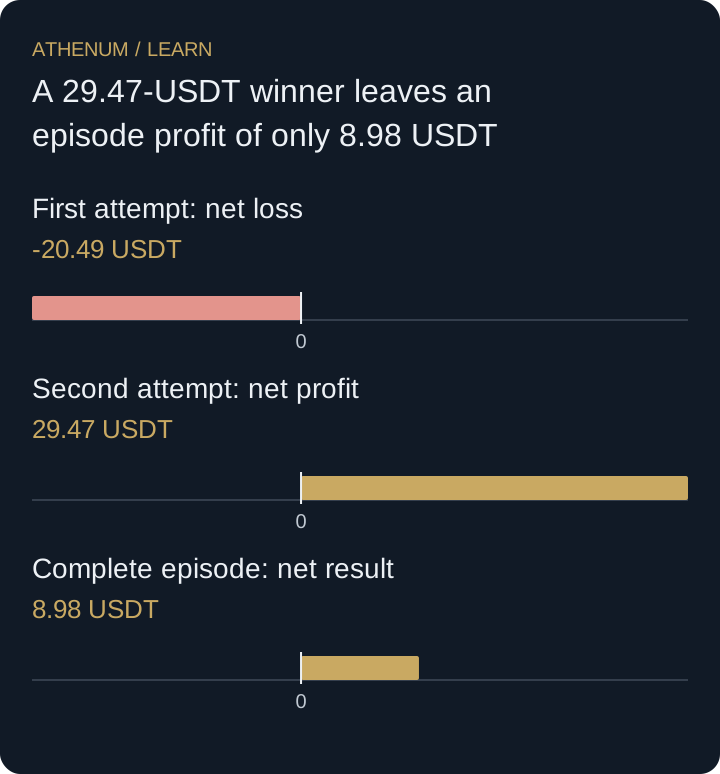 Open full-size diagram
- First attempt: net loss: -20.49 USDT
- Second attempt: net profit: 29.47 USDT
- Complete episode: net result: 8.98 USDT
A later recovery does not justify exceeding the budget
In the invented price path, the larger second position earns more. That does not make exceeding a predetermined episode budget a sound decision. If the second attempt had also stopped out, the two five-unit attempts would have lost 31 USDT in total under the same fee assumptions, exceeding the 25-USDT plan. Judge compliance using information available at the decision time, separately from whether this particular outcome happened to be favorable.
Before acting
- Define the episode boundary and permitted number of attempts in advance.
- Link all attempts with a shared episode identifier.
- Reconcile confirmed position closures and every fee.
- Recalculate the remaining episode budget before each re-entry.
- Evaluate rule compliance separately from the later outcome.
Check your understanding
Which second entry fits the remaining 4.51-USDT budget: five or two units at 103 with a stop at 101 and the same fees?
Show the explained answer
Only two units fit: their further planned loss is 4.204 USDT. Five units would risk 10.51 USDT. Including the first net loss, a second stop would leave total losses of 24.694 or 31 USDT, respectively. This remains a plan under the assumed execution prices, not a guarantee of maximum realized loss.