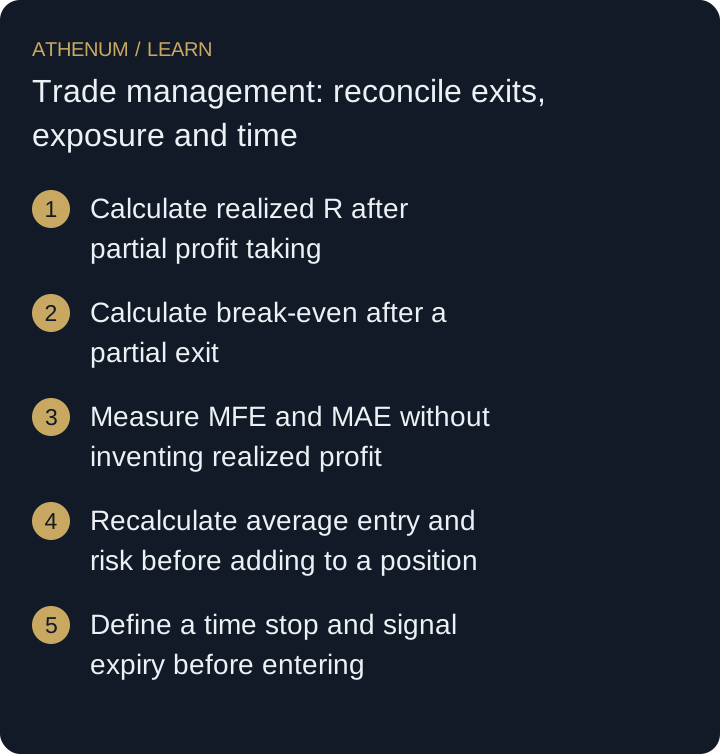
Trade management: reconcile exits, exposure and time
Calculate partial-exit R, cost-adjusted break-even, observed MFE and MAE, add-on risk and time stops using complete hypothetical trading ledgers.
What you will practise
Reconcile what was actually filled, what remains exposed and which exit rule applies, without substituting a chart target or hindsight for a position ledger.
Before you start
- Calculate linear position P&L and fees on execution notional.
- Distinguish a stop trigger, an order acknowledgement and a confirmed fill.
Course outline
- 1
Calculate realized R after partial profit taking
Weight each actual exit by its share of the original position, deduct every fee and keep the original risk denominator. A touched target is not the whole trade result.
8 min - 2
Calculate break-even after a partial exit
Separate an entry-price stop, the remaining position’s break-even and whole-trade break-even. Include prior partial profits, paid fees and exit-notional costs.
9 min - 3
Measure MFE and MAE without inventing realized profit
Calculate sampled favorable and adverse excursions from a declared price and depth series, then reconcile them with the actual filled exit and net result.
8 min - 4
Recalculate average entry and risk before adding to a position
Size an addition from the combined position’s planned stop loss and all fees. Reconcile the new average entry without spending the same risk budget twice.
9 min - 5
Define a time stop and signal expiry before entering
Separate signal expiry, maximum holding time and order time in force. Reconcile the actual timed exit, execution delay and costs under a fixed rule.
8 min
 Open full-size diagram
- Calculate realized R after partial profit taking
- Calculate break-even after a partial exit
- Measure MFE and MAE without inventing realized profit
- Recalculate average entry and risk before adding to a position
- Define a time stop and signal expiry before entering
Educational material. Examples do not establish a profitable strategy. Trading costs, gaps and liquidation can produce losses beyond a planned stop.