Funding research: reconcile payments, rates and hedge decisions
Explain funding forecast errors, reconstruct changed settlement schedules, attribute OI-weighted rates and calculate borrowing and hedge-exit scenarios.
What you will practise
Build an auditable funding ledger and separate changes in rates, exposure, market weights and future carrying costs before comparing hedge decisions.
Before you start
- Complete Funding and basis, including the full spot–perpetual ledger.
- Understand linear contract notional, signed cash flows, basis points and open-interest units.
Course outline
- 1
Funding forecast vs payment: explain the rate and exposure gap
Reconcile estimated and settled funding. Separate the effect of a changed rate from changed exposure, then check the account's actual funding entry.
9 min - 2
Funding interval changes: rebuild the actual settlement ledger
Reconstruct a holding window across an eight-hour-to-hourly funding change. Match effective schedules, eligible positions, settled rates and posted payments.
8 min - 3
OI-weighted funding: separate rate changes from changing weights
Explain why aggregate funding can rise while every constituent rate falls. Calculate an exact rate effect and OI-weight effect on a consistent panel.
9 min - 4
Funding minus borrow costs: account for rate resets and repayment
Calculate net carry from actual funding and a changing loan balance. Include hourly rate resets, partial repayment and costs after the trade closes.
9 min - 5
Funding turns negative: compare holding a hedge with closing it
Compare hedge exits from the current decision time. Separate sunk funding from future basis changes, funding payments, borrowing and execution costs.
10 min
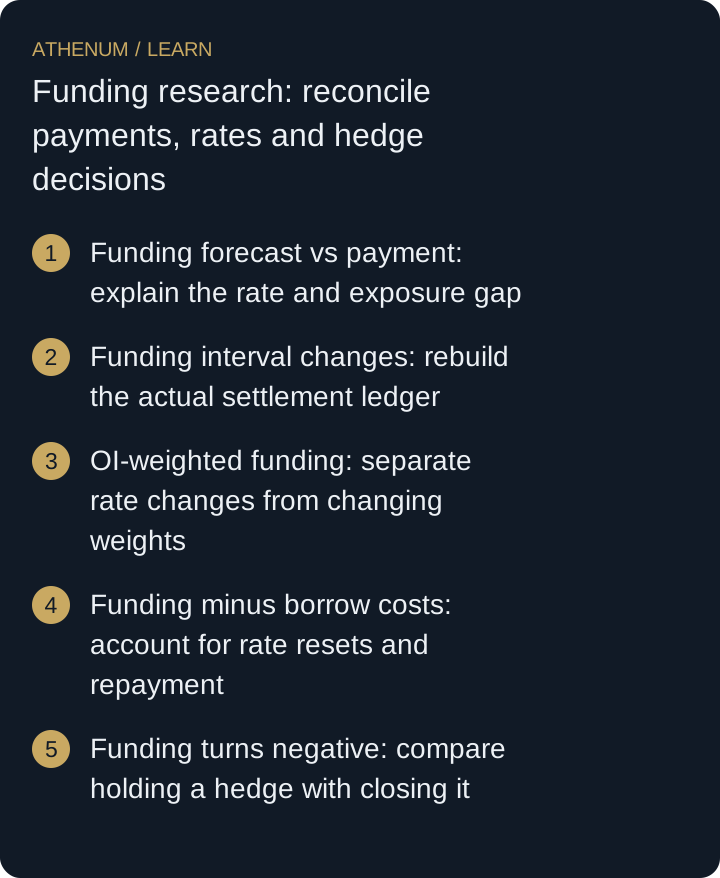 Open full-size diagram
- Funding forecast vs payment: explain the rate and exposure gap
- Funding interval changes: rebuild the actual settlement ledger
- OI-weighted funding: separate rate changes from changing weights
- Funding minus borrow costs: account for rate resets and repayment
- Funding turns negative: compare holding a hedge with closing it
Educational material. Examples do not establish a profitable strategy. Trading costs, gaps and liquidation can produce losses beyond a planned stop.